 Back
BackPrecalculus Study Guide: Rational Functions, Limits, and End Behavior
Study Guide - Smart Notes
 Tailored notes based on your materials, expanded with key definitions, examples, and context.
Q1. For each rational function, write limit statements to describe the left and right end behaviors.
Background
Topic: Rational Functions & Limits
This question tests your understanding of how rational functions behave as approaches positive and negative infinity. You are asked to write limit statements that describe the end behavior (as and ) for each function, using either the algebraic form or the graph.
Key Terms and Formulas:
Rational Function: A function of the form , where and are polynomials.
End Behavior: The behavior of as approaches or .
Limit Statement: and .
Horizontal Asymptote: If , then is a horizontal asymptote.
Step-by-Step Guidance
Identify the degree of the numerator and denominator for each rational function. The degree helps determine the end behavior.
Recall the rules for end behavior:
If degrees are equal:
If numerator degree > denominator degree: grows without bound as
If numerator degree < denominator degree: as
For each function, set up the limit statements for left () and right () end behavior.
Use the graph (if provided) to visually confirm the end behavior and horizontal asymptotes.
Write the limit statements, but stop before calculating the final value. For example: [setup here].
Try solving on your own before revealing the answer!
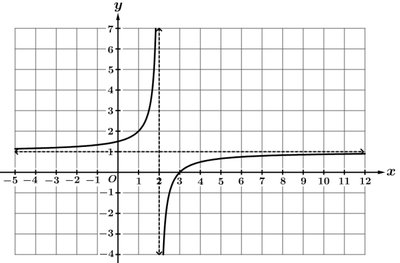
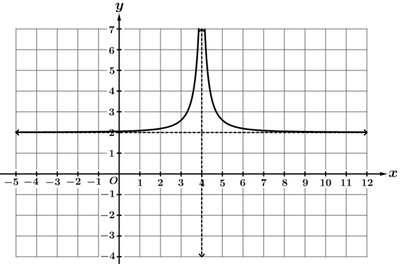
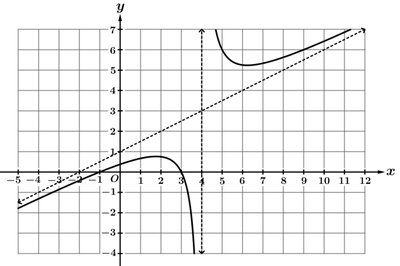
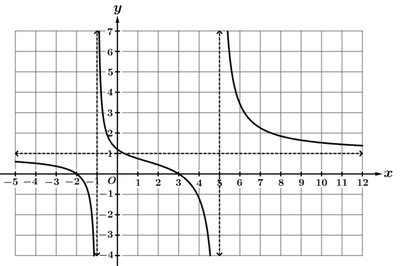
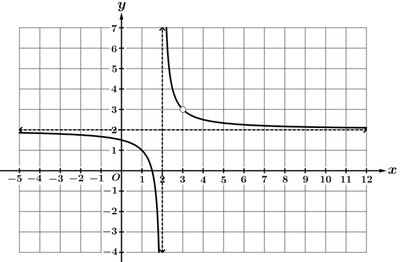
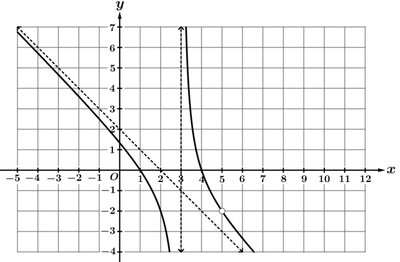
Final Answer:
For each function, the left and right end behaviors are:
1. f(x): ,
2. g(x): ,
3. h(x): ,
4. k(x): ,
5. r(x): ,
6. m(x): ,
These results are based on the degrees and leading coefficients of the rational functions, and confirmed by the graphs.
Q2. Write a limit statement describing the output values for the following graphs and verbal descriptions of the input values.
Background
Topic: Limits at Infinity
This question asks you to write limit statements for the output values as the input values decrease or increase without bound (i.e., as or ).
Key Terms and Formulas:
Limit at Infinity: or
End Behavior: How the function behaves as becomes very large or very small.
Step-by-Step Guidance
Read the verbal description: "input values decrease without bound" means ; "increase without bound" means .
Examine the graph to see what value the function approaches as moves far left or far right.
Set up the limit statement for each scenario, but do not compute the final value yet.
Try solving on your own before revealing the answer!
Final Answer:
7. As :
8. As :
The function approaches the horizontal asymptote as goes to both positive and negative infinity.
Q3. Use the graphs to find the following limits for and .
Background
Topic: One-Sided Limits and Limits at Infinity
This question tests your ability to interpret one-sided limits and limits at infinity from a graph. You are asked to find the value the function approaches from the left or right of a given value, or as approaches infinity.
Key Terms and Formulas:
One-Sided Limit: (from the left), (from the right)
Limit at Infinity: or
Step-by-Step Guidance
Locate the point of interest on the graph (e.g., , , ).
Observe the behavior of the function as approaches the point from the left or right.
Set up the limit statement for each scenario, but do not state the final value yet.
Try solving on your own before revealing the answer!
Final Answer:
9. : 6
10. :
11. : 2
12. : 2
13. :
14. :
15. : 1
16. : 1
These values are determined by observing the direction the graph approaches as nears the specified values.
Q4. For each function, write the left and right limit statements for as approaches 1.
Background
Topic: One-Sided Limits at a Point
This question tests your ability to write and interpret one-sided limits for rational functions as approaches a specific value, especially where the denominator may be zero.
Key Terms and Formulas:
One-Sided Limit: and
Undefined Points: Where the denominator is zero, the function may have a vertical asymptote or a hole.
Step-by-Step Guidance
Factor the numerator and denominator to identify points of discontinuity.
Determine if causes the denominator to be zero, and whether it is a vertical asymptote or a hole.
Set up the left and right limit statements for for each function, but do not state the final value yet.
Try solving on your own before revealing the answer!
Final Answer:
17. : Both left and right limits approach the same value (hole at ).
18. : Both left and right limits approach .
19. : Left limit approaches , right limit approaches (vertical asymptote at ).
These results depend on whether the denominator cancels or creates a vertical asymptote.
Q5. For each rational function, determine and label any values of where the graph has a hole or vertical asymptote.
Background
Topic: Discontinuities in Rational Functions
This question tests your ability to identify holes and vertical asymptotes in rational functions by factoring and analyzing the numerator and denominator.
Key Terms and Formulas:
Hole: Occurs when a factor cancels in both numerator and denominator.
Vertical Asymptote: Occurs when a factor remains in the denominator after simplification.
Step-by-Step Guidance
Factor the numerator and denominator for each function.
Identify values of that make the denominator zero.
Determine if the factor cancels (hole) or remains (vertical asymptote).
Label the values, but do not state the final answer yet.
Try solving on your own before revealing the answer!
Final Answer:
20. : Hole at , vertical asymptote at and .
21. : Hole at , vertical asymptote at .
22. : Vertical asymptote at .
Holes occur where factors cancel; vertical asymptotes occur where the denominator is zero and the factor does not cancel.
Q6. Solve the following inequalities. Write your answers using interval notation.
Background
Topic: Rational Inequalities
This question tests your ability to solve rational inequalities and express the solution in interval notation.
Key Terms and Formulas:
Rational Inequality: An inequality involving a rational expression.
Interval Notation: A way to express the solution set of an inequality.
Step-by-Step Guidance
Set the rational expression equal to zero to find critical points.
Determine where the expression is undefined (denominator zero).
Test intervals between critical points to see where the inequality holds.
Write the solution in interval notation, but do not state the final answer yet.
Try solving on your own before revealing the answer!
Final Answer:
23. :
24. :
25. :
26. :
Solutions are found by analyzing sign changes and where the expression is zero or undefined.
