 Back
Precalculus Study Guide: Sine and Cosine Functions, Domain, Range, Periodicity, and Graphing
Study Guide - Smart Notes
 Tailored notes based on your materials, expanded with key definitions, examples, and context.
Q1. What is the range of sin x and cos x?
Background
Topic: Domain and Range of Trigonometric Functions
This question tests your understanding of the possible output values (range) for the sine and cosine functions.
Key Terms and Formulas
Range: The set of all possible values a function can take.
For and , the values are determined by the unit circle.
On the unit circle, and .
Step-by-Step Guidance
Recall that the sine and cosine functions correspond to the y- and x-coordinates of points on the unit circle.
Think about the maximum and minimum values these coordinates can reach as you move around the circle.
Express the range in interval notation based on these extreme values.
Try solving on your own before revealing the answer!
Final Answer:
The range of and is .
This is because the maximum and minimum values on the unit circle for both functions are 1 and -1, respectively.
Q2. What is the period of sin x and cos x?
Background
Topic: Periodicity of Trigonometric Functions
This question tests your understanding of how often the sine and cosine functions repeat their values.
Key Terms and Formulas
Period: The smallest positive value such that for all .
For and , the period is .
Step-by-Step Guidance
Recall the definition of period for a function.
Think about how the sine and cosine functions behave as you increase by .
Write the period for each function based on their repetition interval.
Try solving on your own before revealing the answer!
Final Answer:
The period of and is .
Both functions repeat their values every units.
Q3. For what angles is sin x = 0?
Background
Topic: Zeros of the Sine Function
This question tests your ability to find the angles where the sine function equals zero.
Key Terms and Formulas
Zero of a function: An input value where the function equals zero.
For , zeros occur at integer multiples of .
Step-by-Step Guidance
Recall the unit circle and where the y-coordinate (sine) is zero.
Identify the angles where this occurs (e.g., , etc.).
Express the general solution for all such angles.
Try solving on your own before revealing the answer!
Final Answer:
at , where is any integer.
This is because the sine function is zero at every integer multiple of .
Q4. For what angles is cos x = 0?
Background
Topic: Zeros of the Cosine Function
This question tests your ability to find the angles where the cosine function equals zero.
Key Terms and Formulas
Zero of a function: An input value where the function equals zero.
For , zeros occur at odd multiples of .
Step-by-Step Guidance
Recall the unit circle and where the x-coordinate (cosine) is zero.
Identify the angles where this occurs (e.g., , etc.).
Express the general solution for all such angles.
Try solving on your own before revealing the answer!
Final Answer:
at , where is any integer.
This is because the cosine function is zero at every odd multiple of .
Q5. Make a table for y = sin x using all the values of sin θ on the unit circle, then connect the points with a smooth curve to get the graph of y = sin x.
Background
Topic: Graphing Sine Function
This question tests your ability to create a table of values and sketch the graph of the sine function using key points from the unit circle.
Key Terms and Formulas
Unit circle: Used to determine values of at key angles.
Key points: .
Step-by-Step Guidance
List the key angles: .
Find the sine value for each angle using the unit circle.
Fill in the table with these values.
Plot the points on a coordinate plane.
Connect the points with a smooth curve to sketch the graph.
Try solving on your own before revealing the answer!
Final Answer:
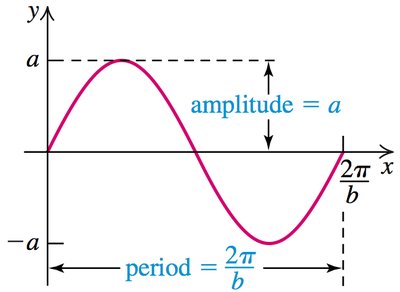
The table for at key points:
,
,
,
,
,
Connecting these points yields the standard sine curve.
Q6. Make a table for y = cos x using all the values of cos θ on the unit circle, then connect the points with a smooth curve to get the graph of y = cos x.
Background
Topic: Graphing Cosine Function
This question tests your ability to create a table of values and sketch the graph of the cosine function using key points from the unit circle.
Key Terms and Formulas
Unit circle: Used to determine values of at key angles.
Key points: .
Step-by-Step Guidance
List the key angles: .
Find the cosine value for each angle using the unit circle.
Fill in the table with these values.
Plot the points on a coordinate plane.
Connect the points with a smooth curve to sketch the graph.
Try solving on your own before revealing the answer!
Final Answer:
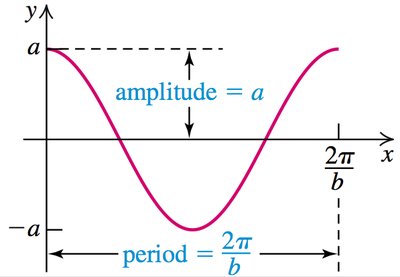
The table for at key points:
,
,
,
,
,
Connecting these points yields the standard cosine curve.
Q7. How far apart are the 1st and 5th values? How far apart are any 2 consecutive values? (this is the step size)
Background
Topic: Step Size in Trigonometric Graphs
This question tests your understanding of the spacing between key points when graphing one period of sine or cosine.
Key Terms and Formulas
Period: The length of one complete cycle ( for and ).
Step size: The distance between consecutive key points.
Step-by-Step Guidance
Identify the 1st and 5th key points (e.g., $0).
Calculate the distance between them (this is the period).
Divide the period by 4 to find the step size between consecutive points.
Try solving on your own before revealing the answer!
Final Answer:
The distance between the 1st and 5th values is (the period).
The step size between any two consecutive values is .
Q8. How does the distance between the 1st and 5th values relate to the period of sin and cos?
Background
Topic: Relationship Between Key Points and Period
This question tests your understanding of how the spacing of key points corresponds to the period of the function.
Key Terms and Formulas
Period: The length of one complete cycle.
Key points: Used to graph one cycle.
Step-by-Step Guidance
Recall that the 1st and 5th key points mark the start and end of one cycle.
Compare the distance between these points to the period.
Express the relationship in terms of the period.
Try solving on your own before revealing the answer!
Final Answer:
The distance between the 1st and 5th values is exactly equal to the period of the function.
This means one cycle is completed between these two points.
Q9. What is the step size in relation to the period?
Background
Topic: Step Size Formula for Trigonometric Functions
This question tests your ability to relate the step size to the period for graphing trigonometric functions.
Key Terms and Formulas
Step size: The interval between consecutive key points.
Formula:
Step-by-Step Guidance
Recall the formula for the period of sine and cosine ( or ).
Divide the period by 4 to find the step size.
Express the step size in terms of the period.
Try solving on your own before revealing the answer!
Final Answer:
The step size is one-fourth of the period: .
This ensures five key points are evenly spaced across one cycle.
Q10. Graph y = −2 cos x over the interval [0, 2π]. Find the amplitude, period, and phase shift of the function.
Background
Topic: Transformations of Cosine Function
This question tests your ability to analyze and graph a cosine function with amplitude and sign changes.
Key Terms and Formulas
Amplitude: (here, so amplitude is $2$).
Period: (here, so period is ).
Phase shift: $0$ (no horizontal shift).
Step-by-Step Guidance
Identify the amplitude: .
Calculate the period: .
Determine the phase shift: (here, ).
List the five key points for one period.
Apply the pattern for to get the y-coordinates.
Try solving on your own before revealing the answer!
Final Answer:
Amplitude: $2$
Period:
Phase shift: $0$
The graph starts at , reaches $0, then $0-2[0, 2\pi]$.
Q11. Graph y = 4 sin (½ x) over a one-period interval. Find the amplitude, period, and phase shift of the function.
Background
Topic: Transformations of Sine Function
This question tests your ability to analyze and graph a sine function with amplitude and period changes.
Key Terms and Formulas
Amplitude: (here, ).
Period: (here, so period is ).
Phase shift: $0$ (no horizontal shift).
Step-by-Step Guidance
Identify the amplitude: .
Calculate the period: .
Determine the phase shift: (here, ).
List the five key points for one period.
Apply the pattern for to get the y-coordinates.
Try solving on your own before revealing the answer!
Final Answer:
Amplitude: $4$
Period:
Phase shift: $0$
The graph starts at , reaches $4, then , then $0[0, 4\pi]$.
Q12. Graph y = sin(x - π/2) over a one-period interval. Find the amplitude, period, and phase shift of the function.
Background
Topic: Phase Shift in Sine Function
This question tests your ability to analyze and graph a sine function with a horizontal shift.
Key Terms and Formulas
Amplitude: (here, ).
Period: (since ).
Phase shift: to the right.
Step-by-Step Guidance
Identify the amplitude: .
Calculate the period: .
Determine the phase shift: (here, ).
List the five key points for one period, starting at the phase shift.
Apply the pattern for to get the y-coordinates.
Try solving on your own before revealing the answer!
Final Answer:
Amplitude: $1$
Period:
Phase shift: to the right
The graph starts at and follows the standard sine pattern over one period.
Q13. Graph y = 3 sin(2x - π/2) over a one-period interval. Find the amplitude, period, and phase shift of the function.
Background
Topic: Amplitude, Period, and Phase Shift in Sine Function
This question tests your ability to analyze and graph a sine function with amplitude, period, and phase shift changes.
Key Terms and Formulas
Amplitude: (here, ).
Period: (here, so period is ).
Phase shift: (here, , so shift is to the right).
Step-by-Step Guidance
Identify the amplitude: .
Calculate the period: .
Determine the phase shift: .
List the five key points for one period, starting at the phase shift.
Apply the pattern for to get the y-coordinates.
Try solving on your own before revealing the answer!
Final Answer:
Amplitude: $3$
Period:
Phase shift: to the right
The graph starts at and follows the sine pattern over one period.
Q14. Graph y = 3 cos(3x + π) + 2 over a one-period interval. Find the amplitude, period, and phase shift of the function.
Background
Topic: Amplitude, Period, Phase Shift, and Vertical Shift in Cosine Function
This question tests your ability to analyze and graph a cosine function with amplitude, period, phase shift, and vertical shift.
Key Terms and Formulas
Amplitude: (here, ).
Period: (here, so period is ).
Phase shift: (here, , so shift is to the left).
Vertical shift: (moves the graph up by 2 units).
Step-by-Step Guidance
Identify the amplitude: .
Calculate the period: .
Determine the phase shift: .
List the five key points for one period, starting at the phase shift.
Apply the pattern for to get the y-coordinates.
Try solving on your own before revealing the answer!
Final Answer:
Amplitude: $3$
Period:
Phase shift: to the left
Vertical shift:
The graph starts at and follows the cosine pattern, shifted up by 2 units, over one period.
Q15. Graph y = sin(-2x + π/3) over a one-period interval. Find the amplitude, period, and phase shift of the function.
Background
Topic: Negative Frequency and Phase Shift in Sine Function
This question tests your ability to analyze and graph a sine function with a negative frequency and phase shift.
Key Terms and Formulas
Amplitude: (here, ).
Period: (here, so period is ).
Phase shift: (here, , so shift is to the left).
Step-by-Step Guidance
Identify the amplitude: .
Calculate the period: .
Determine the phase shift: .
List the five key points for one period, starting at the phase shift.
Apply the pattern for to get the y-coordinates.
Try solving on your own before revealing the answer!
Final Answer:
Amplitude: $1$
Period:
Phase shift: to the left
The graph starts at and follows the sine pattern over one period, reflected due to the negative frequency.
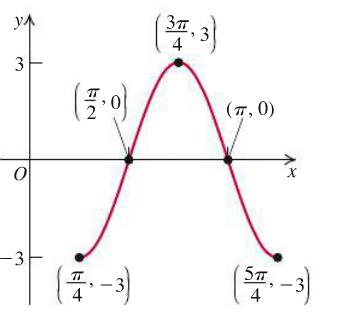
Q16. Write an equation for the sinusoidal graph shown.
Background
Topic: Writing Equations for Sinusoidal Graphs
This question tests your ability to interpret a graph and write the corresponding equation for a sinusoidal function.
Key Terms and Formulas
General form: or
Amplitude: Maximum distance from the midline.
Period:
Phase shift:
Vertical shift:
Step-by-Step Guidance
Identify the amplitude from the graph (distance from midline to peak).
Determine the period by measuring the distance between repeating points.
Find the phase shift by locating where the cycle starts.
Check for any vertical shift (midline not at ).
Choose sine or cosine based on the graph's starting point and shape.
Try solving on your own before revealing the answer!
Final Answer:
The equation for the graph is .
Amplitude: $3\pi\frac{\pi}{4}$ to the right.
