 Back
BackPrecalculus Study Guide: Symmetry and Intercepts of Graphs
Study Guide - Smart Notes
 Tailored notes based on your materials, expanded with key definitions, examples, and context.
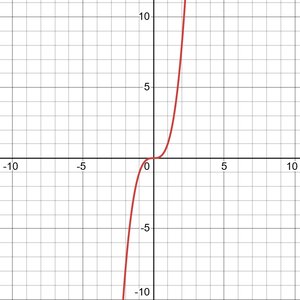
Q1. Determine the symmetry of the given graph.
Background
Topic: Symmetry of Graphs
This question is testing your ability to analyze the symmetry of a graph. In Precalculus, you often need to determine if a graph is symmetric about the y-axis, x-axis, the origin, or if it has no symmetry. Recognizing symmetry helps in understanding the properties of functions and their graphs.
Key Terms and Concepts:
Symmetric about the y-axis: The graph is unchanged when reflected over the y-axis. Algebraically, this means for all in the domain (even function).
Symmetric about the x-axis: The graph is unchanged when reflected over the x-axis. Algebraically, this means replacing with gives the same equation.
Symmetric about the origin: The graph is unchanged when rotated 180° about the origin. Algebraically, this means for all in the domain (odd function).
No symmetry: The graph does not exhibit any of the above symmetries.
Step-by-Step Guidance
Observe the graph and note its general shape and position relative to the axes and the origin.
Check for y-axis symmetry: Imagine folding the graph along the y-axis. Does the left side match the right side? Alternatively, consider if appears true for the graph.
Check for x-axis symmetry: Imagine folding the graph along the x-axis. Does the upper half match the lower half? For most functions, this is uncommon unless the equation is in terms of .
Check for origin symmetry: Imagine rotating the graph 180° about the origin. Does the graph map onto itself? Algebraically, this means .
Based on your observations, decide which symmetry (if any) the graph has. If none of the above symmetries apply, select "No symmetry." Stop here and try to make your selection before moving on.
Try solving on your own before revealing the answer!
Final Answer: Symmetric about the origin
This graph is symmetric about the origin. If you rotate the graph 180° around the origin, it maps onto itself. Algebraically, this is characteristic of odd functions, where .
