 Back
BackPrecalculus Study Guide: Systems of Linear Equations and Applications
Study Guide - Smart Notes
 Tailored notes based on your materials, expanded with key definitions, examples, and context.
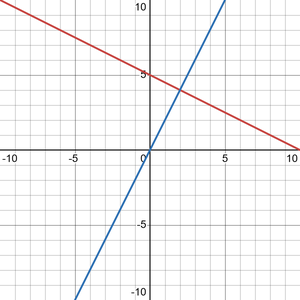
Q1. For the system of equations and , use the graph to determine whether the system has 0 solutions, 1 solution, or infinitely many solutions. If there is one solution, state what it is.
Background
Topic: Systems of Linear Equations (Graphical Solution)
This question tests your ability to interpret the graph of two linear equations and determine the number of solutions to the system. The solution(s) correspond to the point(s) where the lines intersect.
Key Terms and Formulas
System of Linear Equations: Two or more linear equations considered together.
Solution: The point(s) that satisfy both equations.
Graphical Solution: The intersection point(s) of the lines represent the solution(s).
Step-by-Step Guidance
Graph both equations on the same coordinate plane. The first equation, , can be rewritten in slope-intercept form as .
The second equation, , can be rewritten as .
Observe the graph: Do the lines intersect at a single point, are they parallel, or are they the same line?
If they intersect at one point, that point is the unique solution. If they are parallel, there is no solution. If they are the same line, there are infinitely many solutions.
Use the graph to estimate the coordinates of the intersection point, if there is one.
Try solving on your own before revealing the answer!
Final Answer: One solution:
The lines intersect at the point , which is the solution to the system. This means both equations are satisfied when and .
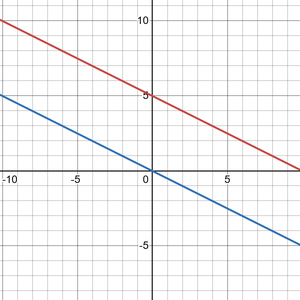
Q2. For the system of equations and , use the graph to determine whether the system has 0 solutions, 1 solution, or infinitely many solutions. If there is one solution, state what it is.
Background
Topic: Systems of Linear Equations (Graphical Solution)
This question tests your ability to recognize when two equations represent the same line (infinitely many solutions) or parallel lines (no solution).
Key Terms and Formulas
Equivalent Equations: If one equation is a multiple of the other, they represent the same line.
Parallel Lines: Lines with the same slope but different intercepts have no solution.
Step-by-Step Guidance
Rewrite both equations in slope-intercept form to compare their slopes and intercepts.
Notice that is exactly three times .
Graph both lines and observe their positions relative to each other.
Determine if the lines coincide (overlap completely) or are distinct.
Try solving on your own before revealing the answer!
Final Answer: Infinitely many solutions.
Both equations represent the same line, so every point on the line is a solution to the system.
Q3. For the system of equations and , use the graph to determine whether the system has 0 solutions, 1 solution, or infinitely many solutions. If there is one solution, state what it is.
Background
Topic: Systems of Linear Equations (Graphical Solution)
This question tests your ability to interpret the intersection of two lines, one of which is already in slope-intercept form.
Key Terms and Formulas
Slope-Intercept Form:
Intersection Point: The solution to the system is where the two lines cross.
Step-by-Step Guidance
Rewrite in slope-intercept form: .
The second equation is already .
Compare the slopes and intercepts of the two lines.
Graph both lines and observe if they are parallel, coincident, or intersect at a single point.
If they intersect, estimate the intersection point from the graph.
Try solving on your own before revealing the answer!
Final Answer: One solution:
The lines intersect at the origin, so is the solution to the system.
Q4. Solve the system of equations and using substitution or elimination.
Background
Topic: Solving Systems of Linear Equations (Algebraic Methods)
This question tests your ability to solve a system of two linear equations using substitution or elimination.
Key Terms and Formulas
Substitution Method: Set the two expressions for equal to each other and solve for .
Elimination Method: Not as direct here, since both equations are solved for .
Step-by-Step Guidance
Since both equations are solved for , set .
Solve for by isolating $x$ on one side of the equation.
Once you have , substitute it back into either original equation to solve for .
Try solving on your own before revealing the answer!
Final Answer:
Setting gives , and substituting back gives .
Q5. Solve the system of equations and using substitution or elimination.
Background
Topic: Solving Systems of Linear Equations (Algebraic Methods)
This question tests your ability to use substitution or elimination to solve a system of two linear equations.
Key Terms and Formulas
Substitution Method: Solve one equation for one variable and substitute into the other.
Elimination Method: Add or subtract equations to eliminate one variable.
Step-by-Step Guidance
Solve the second equation for or (e.g., ).
Substitute this expression into the first equation to get an equation in one variable.
Solve for .
Substitute the value of back into the expression for to find $x$.
Try solving on your own before revealing the answer!
Final Answer:
Solving gives and .
Q6. Solve the system of equations and using substitution or elimination.
Background
Topic: Solving Systems of Linear Equations (Algebraic Methods)
This question tests your ability to substitute a known value for one variable into another equation.
Key Terms and Formulas
Substitution: Directly substitute the value of into the equation for .
Step-by-Step Guidance
Substitute into the equation .
Solve for .
Try solving on your own before revealing the answer!
Final Answer:
Substituting gives .
Q7. Solve the system of equations and using substitution or elimination.
Background
Topic: Solving Systems of Linear Equations (Algebraic Methods)
This question tests your ability to use elimination to solve a system where both equations have the same coefficient.
Key Terms and Formulas
Elimination Method: Subtract one equation from the other to eliminate .
Step-by-Step Guidance
Subtract the first equation from the second to eliminate .
Solve for .
Substitute the value of back into one of the original equations to solve for .
Try solving on your own before revealing the answer!
Final Answer:
Solving gives and .
Q8. Solve the system of equations and using substitution or elimination.
Background
Topic: Solving Systems of Linear Equations (Algebraic Methods)
This question tests your ability to use elimination when the coefficients of are opposites.
Key Terms and Formulas
Elimination Method: Add the two equations to eliminate .
Step-by-Step Guidance
Add the two equations to eliminate and solve for .
Substitute the value of back into one of the original equations to solve for .
Try solving on your own before revealing the answer!
Final Answer:
Solving gives and .
Q9. Solve the system of equations and using substitution or elimination.
Background
Topic: Solving Systems of Linear Equations (Algebraic Methods)
This question tests your ability to use elimination with larger coefficients.
Key Terms and Formulas
Elimination Method: Multiply one or both equations as needed to align coefficients for elimination.
Step-by-Step Guidance
Multiply the first equation by 2 to align the coefficients with the second equation.
Add the two equations to eliminate and solve for .
Substitute the value of back into one of the original equations to solve for .
Try solving on your own before revealing the answer!
Final Answer:
Solving gives and .
Q10. Solve the system of equations and using substitution or elimination.
Background
Topic: Solving Systems of Linear Equations (Algebraic Methods)
This question tests your ability to use elimination with non-matching coefficients.
Key Terms and Formulas
Elimination Method: Multiply each equation by a suitable number to align coefficients for elimination.
Step-by-Step Guidance
Multiply the first equation by 2 and the second by 1 (or vice versa) to align the coefficients.
Add or subtract the equations to eliminate or .
Solve for the remaining variable, then substitute back to find the other variable.
Try solving on your own before revealing the answer!
Final Answer:
Solving gives and .
Q11. The local cinema sells child and adult tickets. They sold a total of 1,200 tickets and brought in a total of $10,875 in revenue in a given week. If each child ticket costs $7.50 and each adult ticket costs $10.00, how many adult tickets were sold that week?
Background
Topic: Systems of Linear Equations (Word Problems)
This question tests your ability to translate a real-world scenario into a system of equations and solve for the unknowns.
Key Terms and Formulas
Let = number of child tickets, = number of adult tickets.
Equation 1 (total tickets):
Equation 2 (total revenue):
Step-by-Step Guidance
Write the two equations based on the information given.
Solve the first equation for (e.g., ).
Substitute this expression for into the second equation.
Solve for (number of adult tickets).
Try solving on your own before revealing the answer!
Final Answer: 750 adult tickets
Solving the system gives adult tickets sold that week.
