 Back
Precalculus Study Notes: Trigonometric Functions and Their Properties
Study Guide - Smart Notes
 Tailored notes based on your materials, expanded with key definitions, examples, and context.
Trigonometric Functions and Their Properties
Graphs of the Six Basic Trigonometric Functions
Trigonometric functions are periodic functions that repeat their values in regular intervals. The six basic trigonometric functions are sine, cosine, tangent, cosecant, secant, and cotangent. Their graphs exhibit unique characteristics such as amplitude, period, and asymptotes.
Graphs of Reciprocal Trigonometric Functions
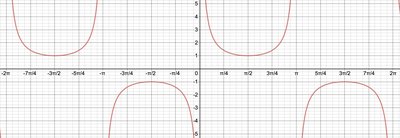
Cosecant (csc): The graph of y = csc(x) is the reciprocal of the sine function. It has a period of and vertical asymptotes wherever (i.e., at integer multiples of ). The graph consists of repeating U-shaped curves above and below the x-axis.
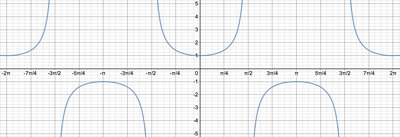
Secant (sec): The graph of y = sec(x) is the reciprocal of the cosine function. It also has a period of and vertical asymptotes wherever (i.e., at odd multiples of ). The graph consists of repeating U-shaped curves similar to cosecant but shifted horizontally.
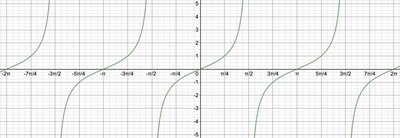
Tangent (tan): The graph of y = tan(x) has a period of and vertical asymptotes wherever . The function passes through the origin and increases or decreases without bound between asymptotes.
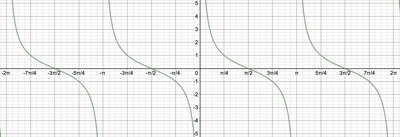
Cotangent (cot): The graph of y = cot(x) has a period of and vertical asymptotes wherever . The function decreases from positive to negative infinity between asymptotes.
Summary Table: Properties of Trigonometric Functions
The following table summarizes the main properties of the six trigonometric functions:
Function | Domain | Range | Period | Asymptotes |
|---|---|---|---|---|
sin(x) | None | |||
cos(x) | None | |||
tan(x) | ||||
csc(x) | ||||
sec(x) | ||||
cot(x) |
Note: is any integer.
Key Points
Periodicity: Sine, cosine, secant, and cosecant have period ; tangent and cotangent have period .
Asymptotes: Secant and tangent have vertical asymptotes where cosine is zero; cosecant and cotangent have vertical asymptotes where sine is zero.
Amplitude: Sine and cosine have amplitude 1; tangent, cotangent, secant, and cosecant do not have amplitude since their range is unbounded.
