 Back
Precalculus Trigonometry Review: Polar Coordinates, Vectors, Conic Sections
Study Guide - Smart Notes
 Tailored notes based on your materials, expanded with key definitions, examples, and context.
Q1. Match the point \( \left(4, \frac{4\pi}{3}\right) \) in polar coordinates with either A, B, C, or D on the graph.
Background
Topic: Polar Coordinates
This question tests your ability to interpret and plot points given in polar coordinates on a graph, and to match them with labeled points.
Key Terms and Formulas:
Polar coordinates: \( (r, \theta) \), where \( r \) is the radius (distance from origin) and \( \theta \) is the angle measured from the positive x-axis.
To plot: Move \( r \) units from the origin along the direction of angle \( \theta \).
Step-by-Step Guidance
Identify the value of \( r = 4 \) and \( \theta = \frac{4\pi}{3} \).
Recall that \( \frac{4\pi}{3} \) radians is greater than \( \pi \) (180°), so it is in the third quadrant.
On the graph, locate the ray corresponding to \( \frac{4\pi}{3} \) and count 4 units from the origin along that direction.
Compare the location with the labeled points A, B, C, and D to determine which matches.
Try solving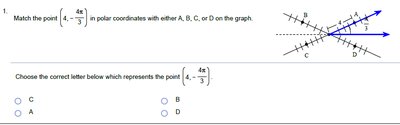 on your own before revealing the answer!
Final Answer: D
The point \( \left(4, \frac{4\pi}{3}\right) \) is located 4 units from the origin along the ray at \( \frac{4\pi}{3} \) radians, which matches point D on the graph.
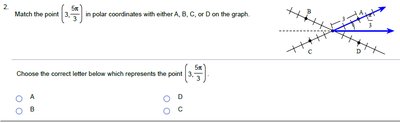
Q2. Match the point \( \left(5, \frac{5\pi}{3}\right) \) in polar coordinates with either A, B, C, or D on the graph.
Background
Topic: Polar Coordinates
This question tests your ability to plot a point given in polar coordinates and match it to a labeled point on a graph.
Key Terms and Formulas:
Polar coordinates: \( (r, \theta) \)
\( \frac{5\pi}{3} \) radians is just before completing a full circle (close to 300°).
Step-by-Step Guidance
Identify \( r = 5 \) and \( \theta = \frac{5\pi}{3} \).
Determine which quadrant \( \frac{5\pi}{3} \) lies in (it is in the fourth quadrant).
Locate the ray for \( \frac{5\pi}{3} \) and move 5 units from the origin along that direction.
Compare with the labeled points to find the match.
Try solving on your own before revealing the answer!
Final Answer: B
The point \( \left(5, \frac{5\pi}{3}\right) \) is 5 units from the origin along the ray at \( \frac{5\pi}{3} \) radians, which matches point B on the graph.
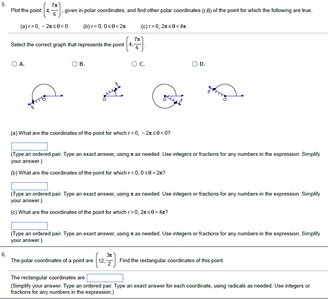
Q5. Plot the point \( \left(7, \frac{7\pi}{4}\right) \) in polar coordinates, and find other polar coordinates (r, θ) for the point for which the following are true: (a) r > 0, -2π < θ < 0; (b) r < 0, 0 < θ < 2π; (c) r > 0, 2π < θ < 4π.
Background
Topic: Polar Coordinates and Multiple Representations
This question tests your understanding of how a single point in polar coordinates can be represented in multiple ways, depending on the sign of r and the range of θ.
Key Terms and Formulas:
Polar coordinates: \( (r, \theta) \)
\( r > 0 \): θ is the standard angle.
\( r < 0 \): θ is opposite direction (add π to θ).
\( r > 0 \), θ outside [0, 2π]: add or subtract multiples of 2π.
Step-by-Step Guidance
Start with \( r = 7 \), \( \theta = \frac{7\pi}{4} \).
For (a): Find an equivalent angle in the range \( -2\pi < \theta < 0 \) by subtracting \( 2\pi \).
For (b): To use \( r < 0 \), add \( \pi \) to \( \theta \) and change the sign of r.
For (c): To use \( r > 0 \), add \( 2\pi \) to \( \theta \) to get an angle in \( 2\pi < \theta < 4\pi \).
Write each new coordinate pair in the form \( (r, \theta) \).
Try solving on your own before revealing the answer!
Final Answer:
(a) \( (7, -\frac{\pi}{4}) \) (b) \( (-7, \frac{3\pi}{4}) \) (c) \( (7, \frac{15\pi}{4}) \)
Each representation uses the appropriate sign and range for r and θ.
Q7. The polar coordinates of a point are (-5, 0). Find the rectangular coordinates of this point.
Background
Topic: Polar to Rectangular Conversion
This question tests your ability to convert from polar coordinates to rectangular (Cartesian) coordinates.
Key Terms and Formulas:
Polar coordinates: \( (r, \theta) \)
Rectangular coordinates: \( (x, y) \)
Conversion formulas:
Step-by-Step Guidance
Identify \( r = -5 \) and \( \theta = 0 \).
Calculate \( x = r \cos \theta \) and \( y = r \sin \theta \).
Recall that \( \cos 0 = 1 \) and \( \sin 0 = 0 \).
Plug in the values to find x and y.
Try solving on your own before revealing the answer!
Final Answer: (-5, 0)
Using the conversion formulas, the rectangular coordinates are (-5, 0).
Q8. The polar coordinates of a point are \( \left(2, \frac{6\pi}{5}\right) \). Find the rectangular coordinates of this point.
Background
Topic: Polar to Rectangular Conversion
This question tests your ability to convert polar coordinates to rectangular coordinates using trigonometric functions.
Key Terms and Formulas:
Polar coordinates: \( (r, \theta) \)
Rectangular coordinates: \( (x, y) \)
Conversion formulas:
Step-by-Step Guidance
Identify \( r = 2 \) and \( \theta = \frac{6\pi}{5} \).
Calculate \( x = 2 \cos \left(\frac{6\pi}{5}\right) \) and \( y = 2 \sin \left(\frac{6\pi}{5}\right) \).
Evaluate the cosine and sine values for \( \frac{6\pi}{5} \).
Express the answer as an ordered pair.
Try solving on your own before revealing the answer!
Final Answer:
The rectangular coordinates are \( \left(2 \cos \left(\frac{6\pi}{5}\right), 2 \sin \left(\frac{6\pi}{5}\right)\right) \approx (-1.618, -1.175) \).
These values are calculated using the conversion formulas.
Q9. The rectangular coordinates of a point are (13, 0). Find the polar coordinates.
Background
Topic: Rectangular to Polar Conversion
This question tests your ability to convert from rectangular coordinates to polar coordinates.
Key Terms and Formulas:
Rectangular coordinates: \( (x, y) \)
Polar coordinates: \( (r, \theta) \)
Conversion formulas:
Step-by-Step Guidance
Identify \( x = 13 \) and \( y = 0 \).
Calculate \( r = \sqrt{13^2 + 0^2} \).
Calculate \( \theta = \arctan\left(\frac{0}{13}\right) \).
Express the polar coordinates as an ordered pair.
Try solving on your own before revealing the answer!
Final Answer: (13, 0)
The polar coordinates are (13, 0), since the point lies on the positive x-axis.
Q10. The rectangular coordinates of a point are (-10, 0). Find the polar coordinates.
Background
Topic: Rectangular to Polar Conversion
This question tests your ability to convert from rectangular coordinates to polar coordinates, especially when x is negative.
Key Terms and Formulas:
Rectangular coordinates: \( (x, y) \)
Polar coordinates: \( (r, \theta) \)
Conversion formulas:
Step-by-Step Guidance
Identify \( x = -10 \) and \( y = 0 \).
Calculate \( r = \sqrt{(-10)^2 + 0^2} \).
Calculate \( \theta = \arctan\left(\frac{0}{-10}\right) \).
Since x is negative, \( \theta \) is \( \pi \) radians.
Express the polar coordinates as an ordered pair.
Try solving on your own before revealing the answer!
Final Answer: (10, \pi)
The polar coordinates are (10, \pi), since the point lies on the negative x-axis.
Q11. The rectangular coordinates of a point are (5, 5√3). Find polar coordinates for the point.
Background
Topic: Rectangular to Polar Conversion
This question tests your ability to convert from rectangular coordinates to polar coordinates using trigonometric relationships.
Key Terms and Formulas:
Rectangular coordinates: \( (x, y) \)
Polar coordinates: \( (r, \theta) \)
Conversion formulas:
Step-by-Step Guidance
Identify \( x = 5 \), \( y = 5\sqrt{3} \).
Calculate \( r = \sqrt{5^2 + (5\sqrt{3})^2} \).
Calculate \( \theta = \arctan\left(\frac{5\sqrt{3}}{5}\right) \).
Simplify the expressions for r and θ.
Try solving on your own before revealing the answer!
Final Answer: (10, \frac{\pi}{3})
The polar coordinates are (10, \frac{\pi}{3}), since \( r = 10 \) and \( \theta = \frac{\pi}{3} \).
