 Back
BackProbability with a Spinner – Step-by-Step Guidance
Study Guide - Smart Notes
 Tailored notes based on your materials, expanded with key definitions, examples, and context.
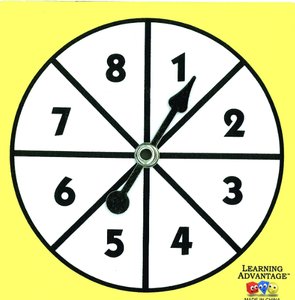
Q16. The spinner at the right is spun 1 time. Find each of the following probabilities:
a)
b)
c)
Background
Topic: Basic Probability (Discrete Sample Space)
This question tests your understanding of probability concepts using a spinner with equally likely outcomes. You are asked to find probabilities for different events based on the numbers shown on the spinner.
Key Terms and Formulas
Probability (): The likelihood of an event occurring, calculated as
Even numbers: Numbers divisible by 2 (on this spinner: 2, 4, 6, 8)
Prime numbers: Numbers greater than 1 with only two positive divisors: 2, 3, 5, 7
"Or" Probability: For mutually exclusive events,
"And" Probability: For independent events,
Step-by-Step Guidance
Identify the total number of possible outcomes. The spinner has 8 sections, so there are 8 possible outcomes.
For part (a), list the numbers that satisfy "2 or 3". These are two separate outcomes: 2 and 3.
For part (b), list the numbers that are even or a 3. Even numbers are 2, 4, 6, 8. Add 3 to this list (since it's not even).
For part (c), determine which numbers are both prime and even. On this spinner, the only even prime is 2.
Set up the probability formula for each part, but do not calculate the final value yet:
(a)
(b)
(c)
Try solving on your own before revealing the answer!
Final Answers:
(a)
(b)
(c)
Each probability is calculated by counting the favorable outcomes and dividing by the total number of spinner sections.
