 Back
Properties of Sine and Cosine Functions
Study Guide - Smart Notes
 Tailored notes based on your materials, expanded with key definitions, examples, and context.
Trigonometric Functions
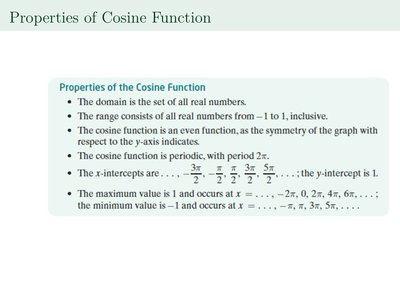
Properties of the Cosine Function
The cosine function is a fundamental trigonometric function, commonly used in Precalculus to describe periodic phenomena and analyze waveforms. Understanding its properties is essential for solving equations and graphing trigonometric functions.
Domain: The domain of the cosine function is the set of all real numbers.
Range: The range consists of all real numbers from -1 to 1, inclusive.
Even Function: The cosine function is an even function, which means it is symmetric with respect to the y-axis. Mathematically, .
Periodicity: The cosine function is periodic with period . This means for all .
x-intercepts: The x-intercepts occur at
y-intercept: The y-intercept is 1.
Maximum Value: The maximum value is 1 and occurs at
Minimum Value: The minimum value is -1 and occurs at
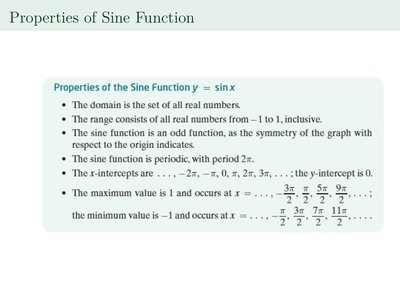
Properties of the Sine Function
The sine function is another fundamental trigonometric function, widely used in Precalculus for modeling periodic behavior and solving trigonometric equations. Its properties are crucial for understanding the behavior of waves and oscillations.
Domain: The domain of the sine function is the set of all real numbers.
Range: The range consists of all real numbers from -1 to 1, inclusive.
Odd Function: The sine function is an odd function, which means it is symmetric with respect to the origin. Mathematically, .
Periodicity: The sine function is periodic with period . This means for all .
x-intercepts: The x-intercepts occur at
y-intercept: The y-intercept is 0.
Maximum Value: The maximum value is 1 and occurs at
Minimum Value: The minimum value is -1 and occurs at
Example: The graphs of and both oscillate between -1 and 1, repeating every units along the x-axis. These properties are used to solve equations such as or , and to analyze the behavior of periodic functions in physics and engineering.
