 Back
BackPulley and Belt: Linear and Angular Velocity
Study Guide - Smart Notes
 Tailored notes based on your materials, expanded with key definitions, examples, and context.
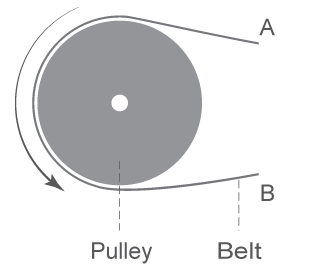
Q3. A pulley belt 4.00 m long takes 2.00 seconds to make one complete revolution. The radius of the pulley is 20.0 cm. (i) What is its linear velocity? (ii) What is the angular velocity?
Background
Topic: Applications of Radian Measure and Circular Motion
This question tests your understanding of linear and angular velocity in the context of circular motion, specifically for a pulley system. You need to relate the distance traveled by the belt to the time taken and use the radius to find angular velocity.
Key Terms and Formulas
Linear velocity (): The rate at which a point on the belt moves along its path.
Angular velocity (): The rate at which the pulley rotates, measured in radians per second.
Key formulas:
Where:
= arclength (distance traveled by the belt in one revolution)
= time for one revolution
= radius of the pulley
= linear velocity
= angular velocity
Step-by-Step Guidance
Identify the known values: m, s, cm m.
Calculate the linear velocity using .
Use the linear velocity and radius to set up the formula for angular velocity: .
Plug in the values for and to find .
Try solving on your own before revealing the answer!
Final Answer:
Linear velocity: m/s
Angular velocity: rad/s
We used the formulas and , plugging in the given values for distance, time, and radius.
