 Back
BackQuadratic Functions, Equations, and Inequalities: Study Notes for College Algebra (Precalculus)
Study Guide - Smart Notes
 Tailored notes based on your materials, expanded with key definitions, examples, and context.
Complex Numbers
The Imaginary Number
The imaginary unit, denoted as i, is defined by the property:
i is the number such that .
This definition allows us to extend the square root operation to negative numbers: for .
Example: Simplify .
Example: Simplify .
Complex Numbers
A complex number is any number of the form , where and are real numbers. Here, $a$ is the real part and is the imaginary part.
Example: has real part 5 and imaginary part -4.
Addition and Subtraction of Complex Numbers
To add or subtract complex numbers, combine like terms (real with real, imaginary with imaginary):
Example:
Multiplication of Complex Numbers
Use the distributive law and replace with :
Example:
Multiply out and simplify, remembering .
Complex Conjugate and Division
The conjugate of is . The product of a complex number and its conjugate is always real:
Example: and are conjugates.
To divide complex numbers, multiply numerator and denominator by the conjugate of the denominator.
Example:
Powers of i
Powers of repeat every four:
For , where is the remainder when is divided by 4.
Quadratic Equations, Functions, and Models
Definition of Quadratic Functions and Equations
A quadratic function is , . A quadratic equation is , .
The zeros of are the solutions to .
Equation-Solving Principles
Zero Product Principle: If , then or .
Square Root Principle: If , then or .
Solving Quadratic Equations by Factoring
Set the equation to zero.
Factor completely.
Set each factor to zero and solve.
Example: yields or .
Solving Quadratic Equations by Square Roots
Isolate the squared term and apply the square root principle.
Example:
Completing the Square
To solve , add to both sides to form a perfect square:
Example: Solve by completing the square.
The Quadratic Formula
The solutions to are:
Example: Solve using the quadratic formula.
The Discriminant
The discriminant determines the nature of the solutions:
If : Two different imaginary solutions.
If : One real solution (repeated root).
If : Two different real solutions.
Equations Reducible to Quadratic Form
Some equations can be solved by substitution to make them quadratic.
Example: (let )
Applications of Quadratic Equations
Word problems involving area, motion, and geometry can often be modeled with quadratic equations.
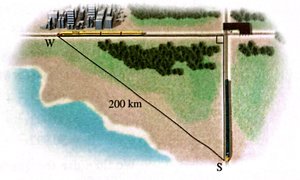
Example: Two trains leave a station at the same time, one west and one south, and are 200 km apart after 2 hours. Find their speeds.
Analyzing the Graphs of Quadratic Functions
Vertex Form of a Quadratic Function
Any quadratic function can be rewritten as , where is the vertex.
Completing the square is used to convert to vertex form.
Graphing Quadratic Functions
The graph of is a parabola:
Horizontal translation: units right (if ) or left (if )
Vertical translation: units up (if ) or down (if )
Vertical stretch/shrink: > 1 stretches, shrinks
Reflection: If , the parabola opens downward
The Vertex Formula
For :
Vertex: ,
Axis of symmetry:
If , the vertex is a minimum; if , the vertex is a maximum.
Solving Rational Equations
To solve rational equations:
Factor denominators and find the least common denominator (LCD).
Multiply both sides by the LCD to clear denominators.
Solve the resulting equation.
Check for extraneous solutions (values that make any denominator zero).
Example:
Solving Radical Equations
A radical equation contains variables inside a radical. To solve:
Isolate the radical.
Raise both sides to the power matching the index of the radical.
Solve the resulting equation.
Check for extraneous solutions.
Example:
Equations with Absolute Values
The absolute value of , , is the distance from $x$ to zero on the number line:
if
if
To solve (), set or .
If , there is no solution.
Example: yields or .
For inequalities:
becomes ("and" compound inequality)
becomes or ("or" compound inequality)
References
Bittinger, Algebra & Trigonometry, Graphs and Models, 6th Edition, Pearson.
