 Back
Rational Expressions: Simplification and Division (Precalculus MATH-107 P.5)
Study Guide - Smart Notes
 Tailored notes based on your materials, expanded with key definitions, examples, and context.
Rational Expressions
Definition and Structure
A rational expression is a fraction in which the numerator and denominator are both polynomials. The denominator must not be zero. Rational expressions are fundamental in algebra and precalculus, as they generalize the concept of fractions to algebraic expressions.
Numerator: The top part of the fraction, a polynomial.
Denominator: The bottom part of the fraction, a polynomial (not equal to zero).
Example:
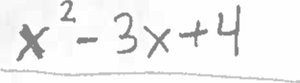
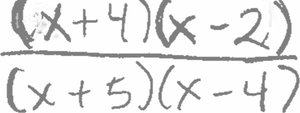
Domain of Rational Expressions
The domain of a rational expression consists of all real numbers except those that make the denominator zero. To find the domain, set the denominator equal to zero and solve for the variable.
Step 1: Factor the denominator if possible.
Step 2: Set each factor equal to zero and solve.
Step 3: Exclude these values from the domain.
Example: For , the domain excludes and .
Simplifying Rational Expressions
Factoring and Reducing
To simplify a rational expression, factor both the numerator and denominator completely, then divide out any common factors.
Step 1: Factor numerator and denominator.
Step 2: Identify and divide out common factors.
Step 3: State the simplified form and specify the domain (values excluded from the original denominator).
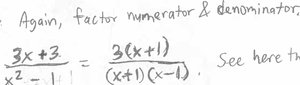
Example: Simplify
Factor numerator: Factor denominator:
Simplified form: ,


Key Points
Always factor completely before simplifying.
State restrictions: Even if a factor cancels, its zero still makes the original expression undefined.
Common factors: Only factors (not terms) can be cancelled.
Dividing Rational Expressions
Process and Example
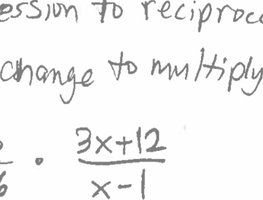
Dividing rational expressions is analogous to dividing numerical fractions: multiply by the reciprocal of the divisor.
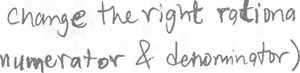
Step 1: Change the division to multiplication by flipping the second rational expression (reciprocal).
Step 2: Factor all numerators and denominators.
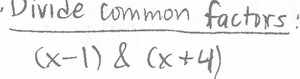
Step 3: Simplify by cancelling common factors.
Step 4: State the domain (exclude values that make any denominator zero in the original problem).
Example:
Step 1: Multiply by reciprocal:
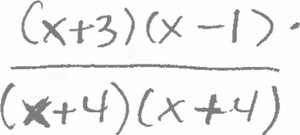
Step 2: Factor:
Step 3: Substitute and simplify:
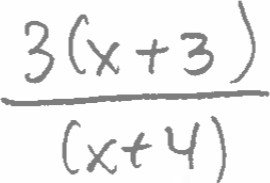
Step 4: Cancel and one :
Domain: Exclude (from any denominator in the original expressions).
Summary Table: Steps for Simplifying and Dividing Rational Expressions
Step | Description |
|---|---|
1. Factor | Factor all numerators and denominators completely. |
2. State Domain | Identify values that make any denominator zero and exclude them. |
3. Simplify | Cancel common factors in numerator and denominator. |
4. For Division | Multiply by the reciprocal of the divisor, then repeat steps 1–3. |
Key Concepts and Reminders
Undefined Values: Any value that makes a denominator zero is excluded from the domain, even if it cancels in simplification.
Factoring: Essential for identifying common factors and simplifying expressions.
Reciprocal: To divide by a rational expression, multiply by its reciprocal.
Example: Factor numerator: Simplified form:

Additional info: These procedures are foundational for later work with rational equations, complex fractions, and applications in calculus.
