 Back
Rational Functions: Analysis, Graphs, and Applications in Precalculus
Study Guide - Smart Notes
 Tailored notes based on your materials, expanded with key definitions, examples, and context.
Rational Functions in Precalculus
Definition and Structure of Rational Functions
Rational functions are quotients of two polynomials, expressed as , where . These functions are fundamental in Precalculus for understanding asymptotic behavior, discontinuities, and graphical analysis.
Numerator : Determines the zeros (x-intercepts) of the function.
Denominator : Determines the vertical asymptotes and possible holes (removable discontinuities).
Domain: All real numbers except where .
Key Features of Rational Functions
Vertical Asymptotes and Holes
Vertical asymptotes occur at values of where the denominator is zero and the numerator is nonzero. Holes occur where both numerator and denominator share a common factor that is zero at a specific -value.
Vertical Asymptote: If and , then is a vertical asymptote.
Hole: If and , then is a hole (removable discontinuity).
Behavior Near Asymptotes: Analyze one-sided limits to describe how the function behaves as approaches the asymptote from the left and right.
Horizontal and Slant (Oblique) Asymptotes
Horizontal and slant asymptotes describe the end behavior of rational functions as approaches infinity or negative infinity.
Horizontal Asymptote: Determined by the degrees of and :
If , then is the horizontal asymptote.
If , then .
If by one, there is a slant (oblique) asymptote found by polynomial division.
Limits at Infinity: and help determine asymptotic behavior.
Intercepts
Intercepts are points where the graph crosses the axes.
x-intercepts: Set and solve for (provided at those points).
y-intercept: Evaluate , if defined.
Graphing Rational Functions
To graph a rational function, follow these steps:
Factor numerator and denominator completely.
Identify and plot vertical asymptotes and holes.
Determine horizontal or slant asymptotes using degree analysis.
Find and plot x- and y-intercepts.
Sketch the graph, considering behavior near asymptotes and intercepts.
Examples and Applications
Example 1: Analyzing
Vertical Asymptote:
Horizontal Asymptote: Degrees are equal;
x-intercept:
y-intercept:
Example 2: Analyzing
Vertical Asymptote:
Horizontal Asymptote: Degrees are equal;
x-intercept:
y-intercept: is undefined
Example 3: Analyzing
Vertical Asymptotes:
Horizontal Asymptote: Degrees are equal;
x-intercepts:
y-intercept:
Special Features: Holes and Removable Discontinuities
When a factor cancels from both numerator and denominator, the function has a hole at that -value. The y-coordinate of the hole is found by simplifying and substituting the -value into the reduced function.
Example: has a hole at and a vertical asymptote at .
Rule of Four (GNAW Approach)
Multiple Representations of Rational Functions
The "Rule of Four" encourages students to analyze rational functions using four perspectives:
Graphic: Sketch or interpret the graph of the function.
Numeric: Create or analyze tables of values.
Algebraic: Manipulate and factor expressions, solve equations.
Words (Verbal): Describe the function's behavior and features in complete sentences.
This approach deepens understanding by connecting different mathematical representations.
Practice and Cooperative Activities
Relay and 4-Way Activities
Group activities such as relays and the 4-Way Activity help students collaboratively analyze rational functions by dividing tasks:
Factoring the function
Finding x- and y-intercepts
Identifying asymptotes and holes
Graphing the function
These activities reinforce the systematic approach to analyzing rational functions and encourage peer learning.
Sample Table: Summary of Rational Function Features
Feature | How to Find | Example |
|---|---|---|
Vertical Asymptote | Set denominator = 0 (after canceling common factors) | for |
Hole | Common factor in numerator and denominator | for |
Horizontal Asymptote | Compare degrees of numerator and denominator | for |
x-intercept | Set numerator = 0 | for |
y-intercept | Evaluate | for |
Sample Graphs
Below are blank coordinate grids for graphing rational functions as part of group activities or practice exercises.
Practice Worksheets
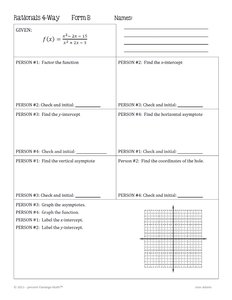
These forms guide students through the systematic analysis of rational functions, including factoring, finding intercepts, asymptotes, and graphing.

Conclusion
Mastering rational functions is essential for success in Precalculus. By systematically analyzing features such as asymptotes, holes, and intercepts, and by using multiple representations, students develop a comprehensive understanding of these important functions.
