 Back
BackRight Triangle Trigonometry: Definitions, Special Angles, and Applications
Study Guide - Smart Notes
 Tailored notes based on your materials, expanded with key definitions, examples, and context.
Chapter 4: Trigonometric Functions
4.3 Right Triangle Trigonometry
Right triangle trigonometry is a foundational topic in precalculus, focusing on the relationships between the angles and sides of right triangles. This section introduces the six trigonometric functions, their definitions based on right triangles, and their applications to special angles and real-world problems.
The Six Trigonometric Functions
The six fundamental trigonometric functions relate the angles of a right triangle to the ratios of its sides. These functions are essential for solving triangles and modeling periodic phenomena.
Sine (sin)
Cosine (cos)
Tangent (tan)
Cosecant (csc)
Secant (sec)
Cotangent (cot)
Right Triangle Definitions of Trigonometric Functions
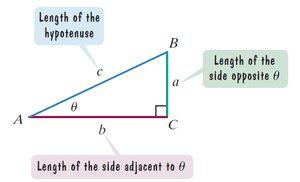
Each trigonometric function is defined as a ratio of two sides of a right triangle, relative to a given acute angle \( \theta \). The triangle below illustrates the sides:
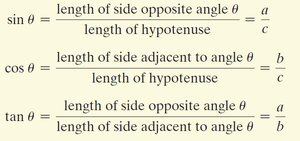
The definitions are as follows:
Sine:
Cosine:
Tangent:
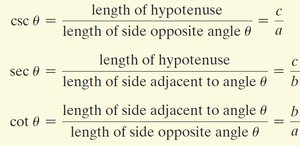
Cosecant:
Secant:
Cotangent:
Key Point: The values of the trigonometric functions depend only on the size of the angle \( \theta \), not on the overall size of the triangle.
Function Values for Some Special Angles
Certain angles, such as 30°, 45°, and 60°, have trigonometric function values that can be determined exactly using special right triangles. These values are frequently used in trigonometry and calculus.
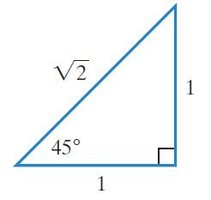
45°-45°-90° Triangle
In a right triangle where the two non-right angles are both 45°, the sides are in the ratio 1:1:. This allows for easy calculation of trigonometric functions for 45°:
30°-60°-90° Triangle
For a triangle with angles 30°, 60°, and 90°, the sides are in the ratio 1::2. This provides the following function values:
,
,
,
Example: To find , use the 45-45-90 triangle: .
Trigonometric Functions and Complements
Trigonometric functions of complementary angles (angles that add up to 90°) are related by cofunction identities. For example, .
Cofunction Identities:
Example:
Applications: Angle of Elevation and Angle of Depression
Angles of elevation and depression are used to describe the angle between a horizontal line and the line of sight to an object above or below the horizontal. These concepts are widely used in navigation, surveying, and physics.
Angle of Elevation: The angle formed by a horizontal line and the line of sight to an object above the horizontal.
Angle of Depression: The angle formed by a horizontal line and the line of sight to an object below the horizontal.
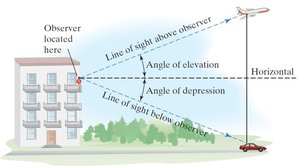
Example: If an observer looks up at an airplane or down at a car from a building, the respective angles are the angle of elevation and angle of depression.
