 Back
Solving Linear Equations and Applications in Precalculus
Study Guide - Smart Notes
 Tailored notes based on your materials, expanded with key definitions, examples, and context.
Equations and Inequalities
Problem Solving with Linear Equations
Linear equations are fundamental tools for modeling and solving real-world problems in algebra and precalculus. The process of solving word problems using linear equations involves a systematic approach:
Step 1: Let x represent one of the unknown quantities.
Step 2: Express other unknowns in terms of x.
Step 3: Write an equation in x that models the problem's conditions.
Step 4: Solve the equation and answer the question.
Step 5: Check the solution in the original context of the problem.
Example 1: Median Starting Salaries
This example demonstrates how to set up and solve a linear equation based on relationships between unknowns.
Given: The median starting salary of a computer science major exceeds that of an education major by $21,000. The median starting salary of an economics major exceeds that of an education major by $14,000. Combined, their median starting salaries are $140,000.
Let x = median starting salary of an education major.
Then, computer science: x + 21; economics: x + 14.
Equation:
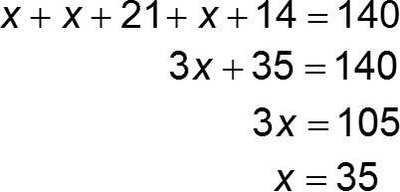
Solution: (education), (computer science), (economics).
Check: (verifies the solution).
Example 2: Comparing Texting Plans
This example illustrates how to model a cost comparison problem with linear equations.
Plan A:
Plan B:
Equation:
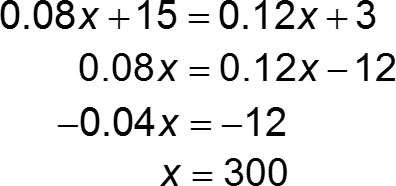
Solution: (the number of texts where costs are equal).
Check: Both plans cost $39 for 300 texts.
Example 3: Price Reduction Problem
This example shows how to find the original price before a percentage reduction using a linear equation.
Let x = original price.
After 30% reduction:
Equation:
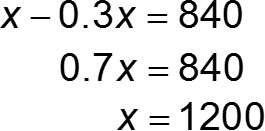
Solution: (original price).
Check: (verifies the solution).
Example 4: Investment Allocation
This example involves dividing an inheritance between two investments with different interest rates to achieve a specified total interest.
Let x = amount invested at 9%.
Amount at 11%:
Equation:
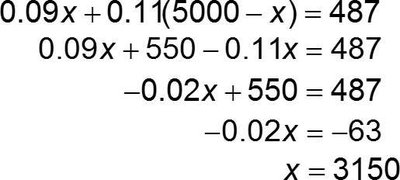
Solution: at 9%, at 11%.
Check: (verifies the solution).
Example 5: Basketball Court Dimensions
This example demonstrates how to use perimeter formulas and linear equations to find the dimensions of a rectangle given a relationship between length and width.
Let x = width; length =
Perimeter:
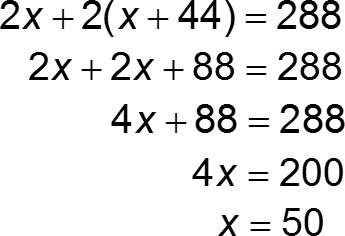
Solution: Width = 50 ft, Length = 94 ft.
Check: (verifies the solution).
Solving a Formula for a Variable
Isolating a Variable in a Formula
Solving a formula for a variable means rewriting the equation so that the chosen variable is alone on one side. This is essential for rearranging equations in algebra and applied mathematics.
Example: Solve for .
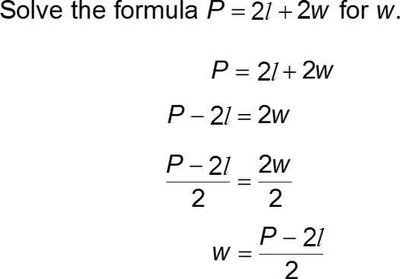
Solution:
Solving a Formula for a Variable That Occurs Twice
Sometimes, the variable to be isolated appears in more than one term. Factorization and algebraic manipulation are used to solve for the variable.
Example: Solve for .
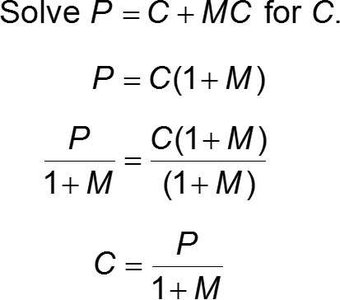
Solution:
