 Back
BackSolving Miscellaneous Polynomial and Radical Equations
Study Guide - Smart Notes
 Tailored notes based on your materials, expanded with key definitions, examples, and context.
Ch. 3 Sec. 4: Miscellaneous Equations
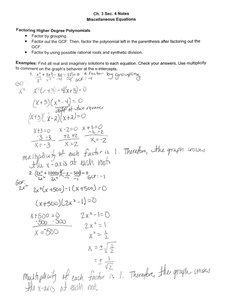
Factoring Higher Degree Polynomials
Factoring is a key technique for solving higher degree polynomial equations. It involves expressing a polynomial as a product of simpler polynomials, which can then be set to zero to find the roots.
Factor by grouping: Group terms to factor common elements and simplify the equation.
Factor out the GCF (Greatest Common Factor): Always factor out the largest common factor first.
Use rational root test and synthetic division: These methods help identify possible rational roots and further factor the polynomial.
Example: Solve $x^4 + 2x^3 - 8x^2 = 0$ by factoring:
Factor out $x^2$: $x^2(x^2 + 2x - 8) = 0$
Factor the quadratic: $x^2(x + 4)(x - 2) = 0$
Set each factor to zero: $x = 0, x = -4, x = 2$
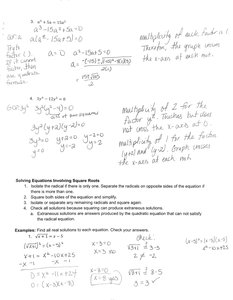
Multiplicity: The multiplicity of a root is the number of times it appears as a solution. If a root has even multiplicity, the graph touches the x-axis at that root; if odd, it crosses the x-axis.
Solving Equations Involving Square Roots
Equations with square roots require isolating the radical and then squaring both sides to eliminate the root. Always check for extraneous solutions, as squaring can introduce invalid answers.
Isolate the radical on one side of the equation.
Square both sides to remove the radical.
Solve the resulting equation.
Check all solutions in the original equation to discard extraneous roots.
Example: Solve $\sqrt{x + 5} = x - 1$:
Square both sides: $x + 5 = (x - 1)^2$
Expand: $x + 5 = x^2 - 2x + 1$
Rearrange: $x^2 - 3x - 4 = 0$
Factor: $(x - 4)(x + 1) = 0$
Solutions: $x = 4, x = -1$
Check both in the original equation to confirm validity.
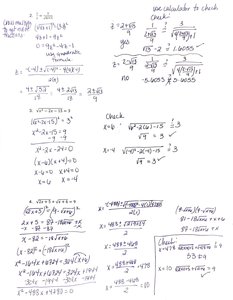
Solving Radical Equations: Additional Examples
Some equations may involve multiple radicals or require more than one squaring step. Always isolate one radical at a time and repeat the process as needed.
Isolate one radical, square both sides, and simplify.
If another radical remains, repeat the process.
Check all solutions in the original equation.
Example: Solve $\sqrt{2x + 3} + 1 = x$:
Isolate the radical: $\sqrt{2x + 3} = x - 1$
Square both sides: $2x + 3 = (x - 1)^2$
Expand: $2x + 3 = x^2 - 2x + 1$
Rearrange: $x^2 - 4x - 2 = 0$
Solve the quadratic equation for $x$.
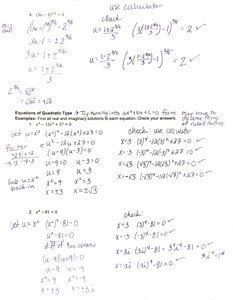
Equations of Quadratic Type
Some higher degree equations can be rewritten in quadratic form by substituting $u = x^n$. This allows the use of standard quadratic solution techniques.
Identify if the equation can be written as $au^2 + bu + c = 0$ by substitution.
Solve for $u$, then back-substitute to solve for $x$.
Check all solutions in the original equation.
Example: Solve $x^4 - 5x^2 + 4 = 0$:
Let $u = x^2$, so $u^2 - 5u + 4 = 0$
Factor: $(u - 4)(u - 1) = 0$
So $u = 4$ or $u = 1$, thus $x^2 = 4$ or $x^2 = 1$
Therefore, $x = \pm2$ or $x = \pm1$
Checking Solutions and Extraneous Roots
It is essential to check all solutions in the original equation, especially when squaring both sides or dealing with radicals. Some solutions may not satisfy the original equation and must be discarded as extraneous.
Substitute each solution back into the original equation.
If a solution does not satisfy the equation, it is extraneous and should be excluded from the final answer.
Example: If $x = 3$ and $x = -2$ are found, check both in the original equation to confirm validity.
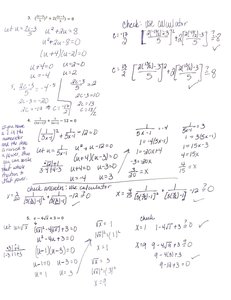
Additional info: These notes cover advanced factoring, solving polynomial and radical equations, and the importance of checking for extraneous solutions—key skills in precalculus.
