 Back
BackSolving Oblique Triangles: The Law of Sines
Study Guide - Smart Notes
 Tailored notes based on your materials, expanded with key definitions, examples, and context.
Applications of Trigonometric Functions
Solving Oblique Triangles
To solve a triangle means to find the measures of all its sides and all its angles. While right triangle trigonometry is limited to right triangles, many real-world problems involve oblique triangles—triangles that do not contain a right angle. To solve these, mathematicians have developed the Law of Sines and the Law of Cosines, which generalize trigonometric relationships to all triangles.
Law of Sines
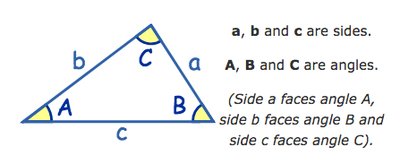
The Law of Sines relates the sides and angles of any triangle (not just right triangles). For any triangle ABC, with sides a, b, and c opposite angles A, B, and C respectively, the Law of Sines states:
When to Use the Law of Sines:
AAS (Angle-Angle-Side) or ASA (Angle-Side-Angle): Two angles and a non-included side are known.
SSA (Side-Side-Angle): Two sides and a non-included angle are known (this is called the ambiguous case).
Solving Triangles Using the Law of Sines
To solve an oblique triangle using the Law of Sines, follow these steps:
Find the missing angle if two angles are known (since the sum of the angles in a triangle is 180°).
Set up the Law of Sines to solve for unknown sides or angles.
Draw a diagram to visualize the triangle and label all known values.
Example 1
Given: triangle ABC, with angle A = 70°, angle B = 80°, and side a = 12 m. Find angle C and sides b and c.
Step 1: Find angle C:
Step 2: Use the Law of Sines to find side b:
Step 3: Use the Law of Sines to find side c:
Example 2
Given: triangle ABC, with angle C = 115°, angle B = 30°, and side a = 12 m. Find angle A and sides b and c.
Step 1: Find angle A:
Step 2: Use the Law of Sines to find side b:
Step 3: Use the Law of Sines to find side c:
The Ambiguous Case (SSA)
When given two sides and an angle not included between them (SSA), the Law of Sines may yield zero, one, or two possible triangles. This is known as the ambiguous case.
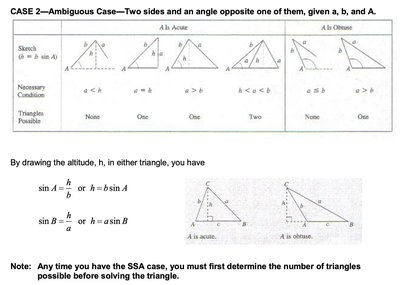
No Solution: If the given values do not form a triangle (e.g., the side opposite the given angle is too short).
One Solution: If the given values form exactly one triangle.
Two Solutions: If the given values allow for two distinct triangles (the angle is acute and the side is long enough to form two different triangles).
To determine the number of solutions:
Calculate the height using (where b is the known side adjacent to angle A).
Compare the given side a to h and b to determine the number of possible triangles.
If two solutions exist, subtract the first found angle from 180° to find the second possible triangle.
Example: SSA Ambiguous Case
Given: <A = 100°, a = 50, b = 34. Use the Law of Sines to determine the number of possible triangles and solve as appropriate.
Applications: Word Problems with the Law of Sines
The Law of Sines is useful for solving real-world problems involving non-right triangles, such as navigation, surveying, and engineering.
Example: A palm tree leans toward an observer at an angle of 78°. At a distance of 60 feet from the base of the tree in the direction of the observer, the angle of elevation to the top of the tree is 41°. Find the length of the palm tree from the base to the top. (Round your answer to the nearest foot.)
Solution Outline: Draw a triangle representing the situation, label all known values, and use the Law of Sines to solve for the unknown side (the length of the tree).
Additional info: The Law of Cosines is another tool for solving oblique triangles, especially when two sides and the included angle (SAS) or all three sides (SSS) are known. However, for the cases discussed here (AAS, ASA, SSA), the Law of Sines is most efficient.
