 Back
BackStudy Guide: Functions and Their Graphs (Precalculus, Ch. 3)
Study Guide - Smart Notes
 Tailored notes based on your materials, expanded with key definitions, examples, and context.
Functions and Their Graphs
Relations and Functions
Understanding the distinction between relations and functions is fundamental in precalculus. A relation is any connection between input (x) and output (y) values, often represented as ordered pairs (x, y). A function is a special type of relation where each input corresponds to at most one output.
Relation: Any set of ordered pairs (x, y).
Function: Each x-value has only one y-value.
Vertical Line Test: A graph represents a function if no vertical line intersects the graph at more than one point.
Example: The relation {(−3, 5), (0, 2), (3, 5)} is a function because each x-value is unique. The relation {(2, 5), (0, 2), (2, 9)} is not a function because x = 2 corresponds to two different y-values.
Verifying Functions from Equations
To determine if an equation defines a function, solve for y in terms of x. If y is uniquely determined for each x, the equation is a function.
Odd powers of y: If y appears with an odd power, the equation may not define a function.
Circles: Equations like are not functions because a single x can correspond to multiple y values.
Function Notation: Replace y with f(x) to express the equation as a function.
Example: is a function; in function notation, .
Domain and Range of a Graph
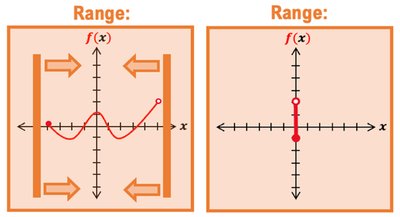
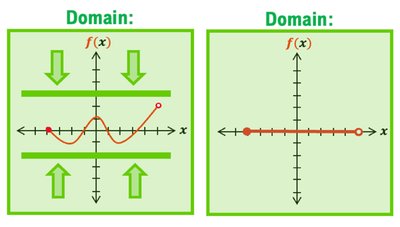
The domain of a function is the set of allowed x-values, and the range is the set of allowed y-values. To find the domain, project the graph onto the x-axis; for the range, project onto the y-axis.
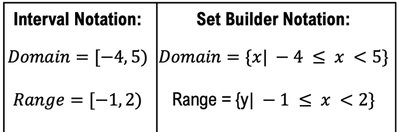
Interval Notation: Uses brackets [ ] for inclusive values and parentheses ( ) for exclusive values.
Set Builder Notation: Describes the domain and range using inequalities.
Union Symbol (∪): Used when the domain or range consists of multiple intervals.
Finding Domain from Equations
When given an equation, determine the domain by identifying values that make the function undefined. Common restrictions include:
Square Roots: The expression under the square root must be non-negative.
Denominators: The denominator must not be zero.
Example: For , the domain is .
Example: For , the domain is .
Common Functions and Their Graphs
Types of Functions
Several basic functions frequently appear in precalculus. Each has a characteristic graph, domain, and range.
Constant Function: ; domain is , range is .
Identity Function: ; domain and range are .
Square Function: ; domain is , range is .
Cube Function: ; domain and range are .
Square Root Function: ; domain is , range is .
Cube Root Function: ; domain and range are .
Transformations of Functions
Types of Transformations
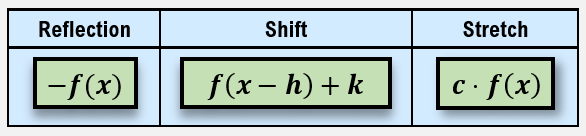
Transformations change the position or shape of a function's graph. The main types are reflections, shifts, and stretches/shrinks.
Reflection: Flips the graph over the x-axis or y-axis. reflects over the x-axis.
Shift: Moves the graph horizontally or vertically. shifts right by h and up by k.
Stretch/Shrink: Multiplies the function by a constant. stretches if , shrinks if .
Reflections
A reflection is a transformation where the function appears to be "folded" over the x-axis or y-axis.
Reflection over x-axis: values change sign: .
Reflection over y-axis: values change sign: .
Example: If , then is a reflection over the x-axis.
Shifts
A shift moves the graph horizontally and/or vertically from its original position.
Vertical Shift: shifts up by ; shifts down by .
Horizontal Shift: shifts right by ; shifts left by .
Example: shifts right by 2 and up by 3.
Stretches and Shrinks
Stretches and shrinks occur when a constant is multiplied inside or outside the function.
Vertical Stretch: , stretches, shrinks.
Horizontal Stretch: , shrinks, stretches.
Example: is a vertical stretch; is a horizontal stretch.
Domain and Range of Transformed Functions
Transformations can alter the domain and range of a function. To find the new domain and range, analyze the transformed graph.
Example: If has domain and range , then has domain and range .
Function Operations
Adding and Subtracting Functions
Functions can be added or subtracted by combining like terms. The domain of the resulting function is the intersection of the domains of the original functions.
Example: , ; .
Multiplying and Dividing Functions
Functions can be multiplied or divided. The domain of the new function is the intersection of the domains, with additional restrictions for division (denominator cannot be zero).
Example: , ; , , domain excludes .
Function Composition
Composing Functions
Function composition involves substituting one function into another. means the output of becomes the input for .
Notation: means .
Example: , ; .
Domain of Composite Functions
To find the domain of a composite function :
Find x-values not defined for .
Find x-values where is not defined.
Example: , ; , domain is and .
Decomposing Functions
Decomposition is the reverse of composition: expressing a function as a composition of two simpler functions.
Example: can be written as where , .
