 Back
Study Guide: Lines and Their Equations in Precalculus
Study Guide - Smart Notes
 Tailored notes based on your materials, expanded with key definitions, examples, and context.
2.3 Lines
Objectives
This section covers fundamental concepts related to lines in the coordinate plane, including slope, equations of lines, and special cases such as parallel and perpendicular lines. Mastery of these topics is essential for understanding linear relationships in precalculus.
Calculating and Interpreting the Slope of a Line
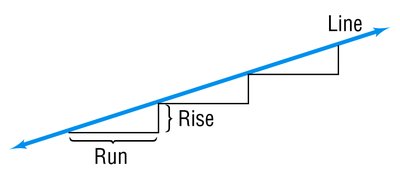
The slope of a line measures its steepness and direction. It is defined as the ratio of the vertical change (rise) to the horizontal change (run) between two points on the line.
Definition: For points and , the slope is given by:
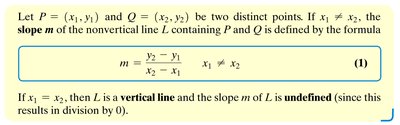
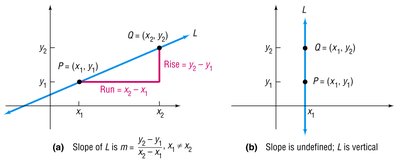
Vertical lines: If , the slope is undefined.
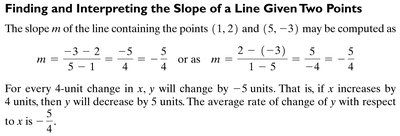
Finding and Interpreting the Slope of a Line Given Two Points
To find the slope between two points, substitute their coordinates into the slope formula. The sign and value of the slope indicate the direction and steepness of the line.
Example: For points and :
For every 4-unit increase in , decreases by 5 units. The average rate of change is .
Types of Slopes and Line Orientation
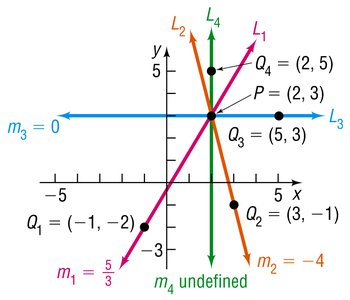
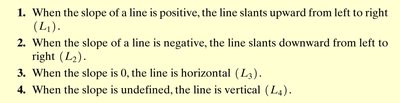
The slope determines the orientation of the line:
Positive slope: Line slants upward from left to right.
Negative slope: Line slants downward from left to right.
Zero slope: Line is horizontal.
Undefined slope: Line is vertical.
Graphing Lines with Different Slopes
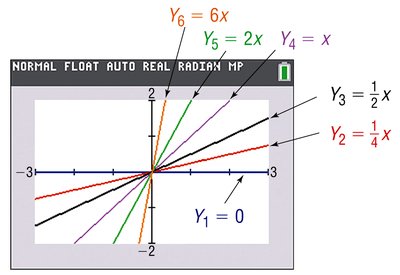
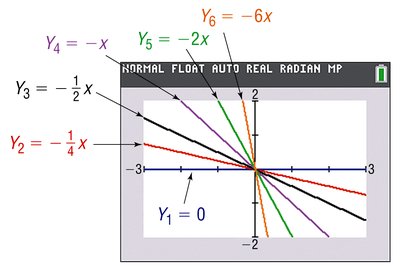
Lines with different slopes can be visualized using graphing technology. The greater the absolute value of the slope, the steeper the line.
Graphing a Line Given a Point and the Slope
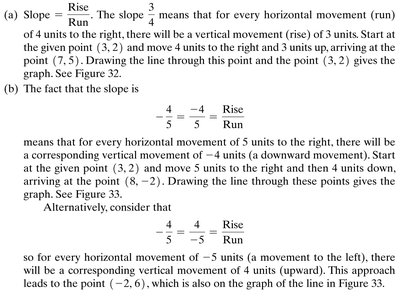
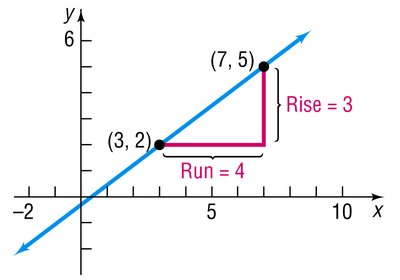
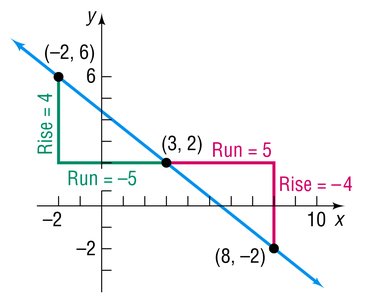
To graph a line given a point and a slope , use the rise and run to plot another point, then draw the line through both points.
Example: Through with slope , move 4 units right and 3 units up to .
With slope , move 5 units right and 4 units down to , or 5 units left and 4 units up to .

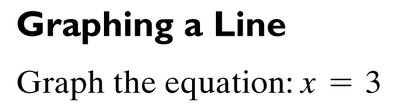
Equation of a Vertical Line
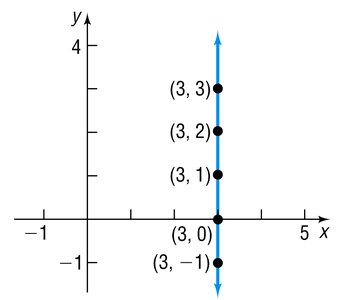
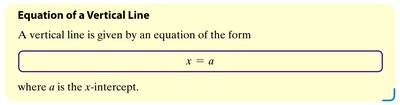
A vertical line has an equation of the form , where is the x-intercept. The slope is undefined.
Example: The line passes through all points with -coordinate 3.
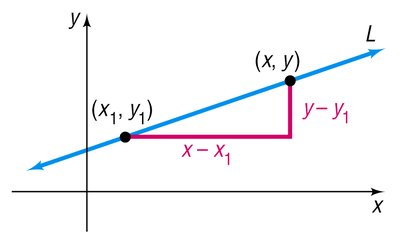
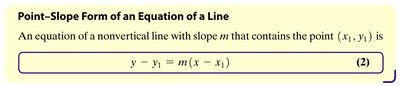
Point-Slope Form of a Line
The point-slope form is useful for writing the equation of a line given a point and the slope:

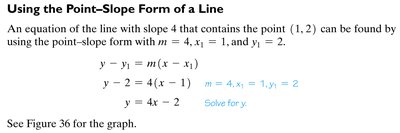
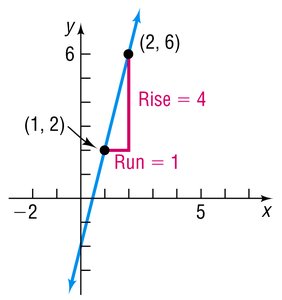
Example: Through with slope $4$:
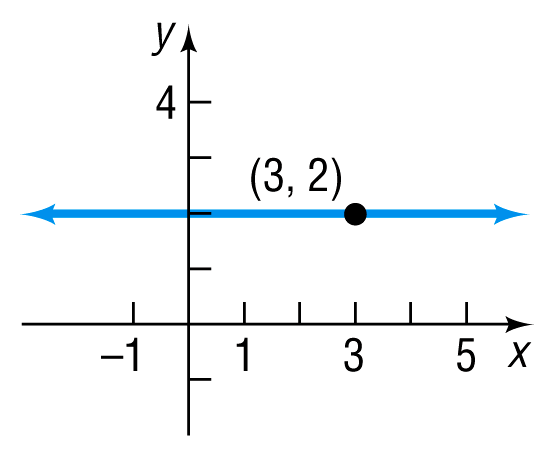
Equation of a Horizontal Line
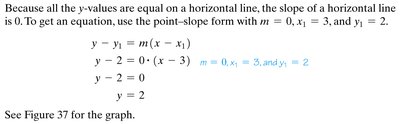
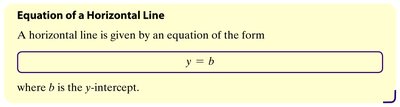
A horizontal line has slope $0y = bb$ is the y-intercept.
Example: Through :
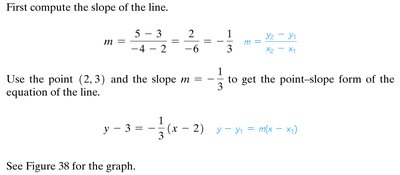
Finding the Equation of a Line Given Two Points
To find the equation of a line through two points, first compute the slope, then use the point-slope form.
Example: Through and :
Slope-Intercept Form of a Line
The slope-intercept form is , where is the slope and is the y-intercept.
Example: has slope $2.

Finding the Slope and y-Intercept from an Equation
To find the slope and y-intercept, rewrite the equation in slope-intercept form.
Example:
Slope is , y-intercept is $2$.
General Form of a Line
The general form of a line is , where , , and are real numbers and $A$ and $B$ are not both zero.
Graphing an Equation in General Form Using Intercepts
To graph a line in general form, find the x-intercept and y-intercept by setting and respectively.
Example:
x-intercept: (when )
y-intercept: (when )
Equations of Parallel Lines
Parallel lines have equal slopes but different y-intercepts. Their equations are of the form and .

Equations of Perpendicular Lines
Perpendicular lines have slopes that are negative reciprocals of each other. If one line has slope , the other has slope .
Type of Line | Slope | Equation Form |
|---|---|---|
Vertical | Undefined | |
Horizontal | 0 | |
General | ||
Parallel | Equal slopes | |
Perpendicular | Negative reciprocal slopes | and |
