 Back
BackStudy Guide: Properties of Rational Functions (Precalculus Chapter 3.5)
Study Guide - Smart Notes
 Tailored notes based on your materials, expanded with key definitions, examples, and context.
Properties of Rational Functions
Definition and Domain of Rational Functions
A rational function is any function that can be written as the ratio of two polynomial functions, where the denominator is not the zero polynomial. The general form is:
Definition: , where p(x) and q(x) are polynomials and q(x) \neq 0.
Domain: The domain of a rational function is all real numbers except those for which the denominator equals zero.
Example: Finding the Domain
For , the domain is all real numbers except .
For , the domain is all real numbers except .
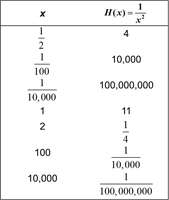
Example: Table of Values for
This table shows how the function behaves for various values of :
x | H(x) = \frac{1}{x^2} |
|---|---|
1/2 | 4 |
1/100 | 10,000 |
1/10,000 | 100,000,000 |
1 | 1 |
2 | 1/4 |
100 | 1/10,000 |
10,000 | 1/100,000,000 |
Graphing Rational Functions
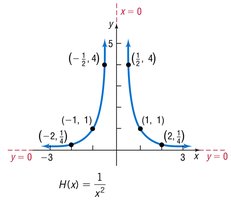
Graphing rational functions involves analyzing their domain, intercepts, symmetry, and asymptotic behavior.
Even Function: is even, so its graph is symmetric about the y-axis.
No x- or y-intercepts: For , the graph does not cross either axis.
Unbounded Behavior: As approaches 0, increases without bound.
Transformations of Rational Functions
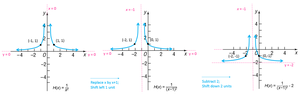
Transformations such as shifts and stretches can be applied to rational functions to obtain new graphs.
Start with the basic graph, then apply horizontal and vertical shifts as indicated by the function's formula.
Asymptotes of Rational Functions
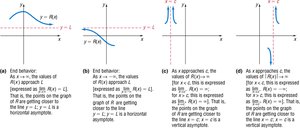
Asymptotes are lines that the graph of a function approaches but never crosses (for vertical asymptotes) or may cross (for horizontal/oblique asymptotes).
Vertical Asymptote: Occurs where the denominator is zero and the function is in lowest terms.
Horizontal Asymptote: Describes the end behavior as approaches infinity.
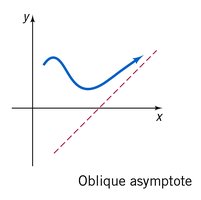
Oblique (Slant) Asymptote: Occurs when the degree of the numerator is one more than the degree of the denominator.
Oblique Asymptotes
If the degree of the numerator is one greater than the denominator, the graph approaches a slant line as becomes large.
Finding Vertical Asymptotes
To find vertical asymptotes, set the denominator equal to zero and solve for . The graph will approach infinity near these values.
Theorem: If has a real zero at , then $x = r$ is a vertical asymptote of .
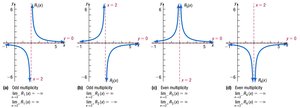
Multiplicity: The behavior near the asymptote depends on the multiplicity of the zero:
Odd multiplicity: The graph approaches on one side and on the other.
Even multiplicity: The graph approaches (or ) on both sides.
Finding Horizontal and Oblique Asymptotes
The type of asymptote depends on the degrees of the numerator () and denominator ():
If : Horizontal asymptote at .
If : Horizontal asymptote at , where and are the leading coefficients.
If : Oblique asymptote found by long division.
If : No horizontal or oblique asymptote; end behavior resembles a power function.
Examples
For , horizontal asymptote at .
For , oblique asymptote found by long division.
For , horizontal asymptote at .
For , no horizontal or oblique asymptote; graph behaves like for large .
Note: A rational function will never have both a horizontal and an oblique asymptote.
