 Back
BackStudy Notes: Linear Functions and Linear Models (Precalculus Chapter 3.1)
Study Guide - Smart Notes
 Tailored notes based on your materials, expanded with key definitions, examples, and context.
Linear Functions and Linear Models
Definition and Properties of Linear Functions
A linear function is a function of the form , where m is the slope and b is the y-intercept. The graph of a linear function is a straight line. The domain of a linear function is typically all real numbers, unless otherwise restricted by context.
Slope (m): Measures the steepness of the line; calculated as the change in y divided by the change in x.
Y-intercept (b): The value of the function when .
Domain: Usually unless context restricts it.
Nonlinear functions: Functions whose graphs are not straight lines.
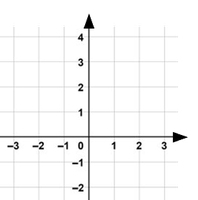
Example: Graphing a linear function on a coordinate plane.
Average Rate of Change and Identification of Linear Functions
The average rate of change of a function between two points and is given by:
For linear functions, the average rate of change is constant for any interval.
This property can be used to identify whether a function is linear.
Theorem: The average rate of change of a linear function is always equal to its slope, m.
Example: Using a table to compute the average rate of change for .
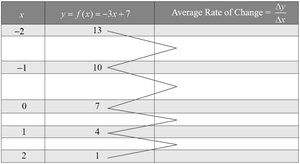
In the table, the average rate of change between any two consecutive x-values is always -3, confirming the function is linear.
Increasing, Decreasing, and Constant Linear Functions
A linear function can be classified based on its slope:
Increasing: If , the function increases over its domain.
Decreasing: If , the function decreases over its domain.
Constant: If , the function is constant (horizontal line).
Example: Determining whether a linear function is increasing, decreasing, or constant by examining its slope.
Building Linear Models from Verbal Descriptions
When the average rate of change between two variables is constant, a linear function can model their relationship. The general form is , where m is the rate of change and b is the initial value (value when ).
Modeling: Translate real-world situations into linear equations by identifying the rate of change and initial value.
Example: Straight-line Depreciation
A company purchases a computer for $3000 and depreciates it over 3 years using the straight-line method.
The depreciation per year is constant.
The linear model for book value as a function of age is , where is the annual depreciation.
Domain: (since the computer is depreciated over 3 years).
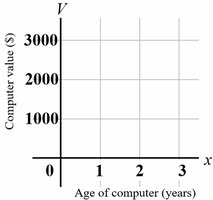
Applications: Find the value after 2 years, or when the value reaches $2000V(x) = 2000$.
Supply and Demand: Linear Models in Economics
Linear functions are used to model supply and demand relationships in economics. The equilibrium price is found where the supply and demand functions intersect.
Supply function: , where is price.
Demand function: , where is price.
Equilibrium: Occurs when .
Equilibrium quantity: The value of or at equilibrium price.
If quantity demanded is greater than quantity supplied, price tends to rise until equilibrium is reached.
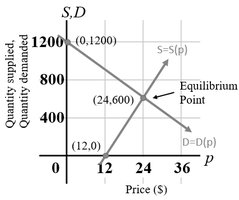
Example: Find equilibrium price and quantity, and analyze what happens when demand exceeds supply.
Additional info: These notes expand on brief points from the original materials, providing definitions, formulas, and context for precalculus students studying linear functions and their applications.
