 Back
BackStudy Notes: Properties and Graphs of Rational Functions
Study Guide - Smart Notes
 Tailored notes based on your materials, expanded with key definitions, examples, and context.
Polynomial and Rational Functions
Definition of Rational Functions
A rational function is any function that can be written in the form , where p(x) and q(x) are polynomial functions and q(x) is not the zero polynomial. The domain of a rational function is all real numbers except those for which the denominator is zero.
Key Point: The domain excludes all real numbers that make .
Example: has domain .
Finding the Domain of a Rational Function
To find the domain, set the denominator equal to zero and solve for the excluded values.
Example: has domain all real numbers, since has no real solutions.
Example: has domain .
Properties of Rational Functions
Vertical Asymptotes
A vertical asymptote occurs at if is a real zero of the denominator (after simplifying the function to lowest terms). The graph approaches infinity or negative infinity as approaches $r$.
Theorem: If is a factor of in lowest terms, then is a vertical asymptote.
Example: has a vertical asymptote at .
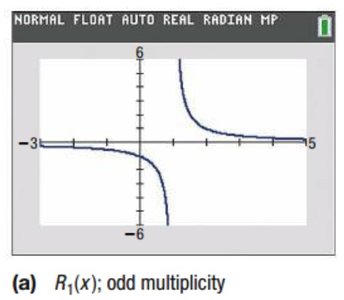
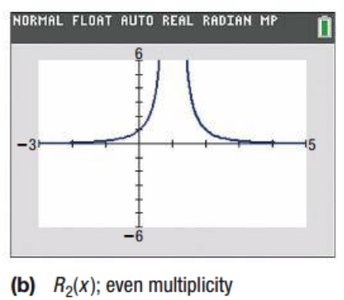
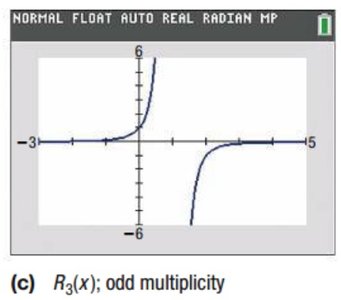
Multiplicity and Vertical Asymptotes
If the multiplicity of the zero is odd, the graph approaches on one side and on the other.
If the multiplicity is even, the graph approaches the same infinity on both sides.
Multiplicity | Graph Behavior |
|---|---|
Odd | Approaches on one side, on the other |
Even | Approaches same infinity on both sides |
Horizontal and Oblique (Slant) Asymptotes
Asymptotes describe the end behavior of rational functions as .
Horizontal Asymptote: If , then is a horizontal asymptote.
Oblique (Slant) Asymptote: If approaches a line as , then $y = ax + b$ is an oblique asymptote.
Degree of Numerator (n) | Degree of Denominator (m) | Asymptote |
|---|---|---|
n < m | m | Horizontal, |
n = m | m | Horizontal, (ratio of leading coefficients) |
n = m + 1 | m | Oblique, (from polynomial division) |
n \geq m + 2 | m | No horizontal or oblique asymptote |
Graphing Rational Functions
To analyze and graph a rational function, follow these steps:
Find the domain by determining where the denominator is zero.
Simplify the function to lowest terms.
Find intercepts: Set numerator to zero for x-intercepts; set for y-intercept (if in domain).
Locate vertical asymptotes by finding real zeros of the denominator in lowest terms.
Determine horizontal or oblique asymptotes using degree comparison.
Check for holes (removable discontinuities) where factors cancel in numerator and denominator.
Sketch the graph using all the above information.
Example: Analyzing
Domain:
x-intercepts:
y-intercept: None (since is not in domain)
Vertical asymptote: (odd multiplicity)
Oblique asymptote: (since degree numerator is one more than denominator)
Holes in the Graph
A hole (removable discontinuity) occurs at if both the numerator and denominator have a common factor , and the function is undefined at $x = a$ but can be simplified elsewhere.
Example: has a hole at and a vertical asymptote at .
Summary Table: Asymptote Types and Graph Behavior
Asymptote Type | Equation | Graph Behavior |
|---|---|---|
Horizontal | As , | |
Vertical | As , | |
Oblique | As , |
Calculator Table Example
Calculator tables can help visualize the behavior of rational functions near asymptotes and holes.
Graphical Examples
Even vs. Odd Multiplicity at Vertical Asymptotes:
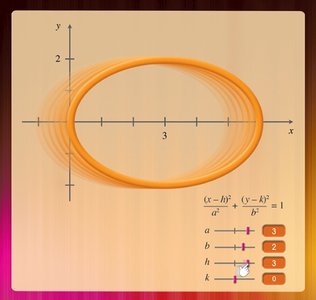
Transformation Example: Shifting and stretching rational functions can be visualized by comparing and .
Multiple Asymptotes: Some rational functions have more than one vertical asymptote, depending on the denominator's factors.
Conclusion
Understanding rational functions involves analyzing their domains, intercepts, asymptotes, and possible holes. Mastery of these concepts is essential for graphing and interpreting rational functions in precalculus.
