 Back
BackSum and Difference Formulas in Trigonometry
Study Guide - Smart Notes
 Tailored notes based on your materials, expanded with key definitions, examples, and context.
Sum and Difference Formulas
Introduction
The sum and difference formulas are essential tools in trigonometry, allowing us to find the exact values of trigonometric functions for non-standard angles by expressing them as sums or differences of common angles. These formulas are also used to simplify expressions and solve trigonometric equations.
Sum and Difference Formulas for Sine, Cosine, and Tangent
Sine Formulas:
Sum:
Difference:

Cosine Formulas:
Sum:
Difference:

Tangent Formulas:
Sum:
Difference:
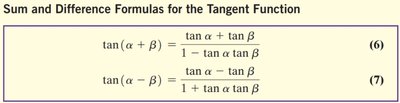
Applications of Sum and Difference Formulas
Finding Exact Values
These formulas are used to find the exact values of trigonometric functions for angles that are not standard, by expressing them as sums or differences of special angles (such as , , , ).
Example: Find .
Express as .
Apply the sum formula:
Substitute known values: , , ,
So,
Simplifying Trigonometric Expressions
Sum and difference formulas can be used to simplify complex trigonometric expressions into simpler forms or to establish identities.
Example: Simplify .
Recognize the cosine difference formula:
So,
Establishing Trigonometric Identities
Using Sum and Difference Formulas
These formulas are also used to prove or establish trigonometric identities by rewriting one side of an equation in terms of the other.
Example: Prove
Rewrite and
Combine and simplify using sum and difference formulas as needed.
Solving Trigonometric Equations
Application in Equations
Sum and difference formulas can be used to solve trigonometric equations, especially when the equation involves sums or differences of angles.
Example: Solve
Isolate one trigonometric function and use identities or algebraic manipulation to solve for .
Reference Table: Pythagorean Triples
Pythagorean triples are sets of three positive integers that satisfy . They are useful in trigonometry for constructing right triangles with integer side lengths.
(3, 4, 5) | (5, 12, 13) | (7, 24, 25) |
|---|---|---|
(8, 15, 17) | (9, 40, 41) | (11, 60, 61) |
(12, 35, 37) | (13, 84, 85) | (15, 112, 113) |
(16, 63, 65) | (17, 144, 145) | (19, 180, 181) |
(20, 21, 29) | (20, 99, 101) | (21, 220, 221) |
Additional info: The above table is included for reference, as Pythagorean triples are often used in trigonometric problems involving right triangles.
