 Back
BackSum, Difference, and Double-Angle Identities in Trigonometry
Study Guide - Smart Notes
 Tailored notes based on your materials, expanded with key definitions, examples, and context.
Trigonometric Identities
Sum and Difference Identities
Sum and difference identities are essential tools in trigonometry, allowing us to express the sine, cosine, or tangent of a sum or difference of two angles in terms of the sines and cosines of the individual angles. These identities are foundational for simplifying expressions, solving equations, and proving other trigonometric identities.
Cosine of a Sum or Difference: The cosine of the sum or difference of two angles can be written as:
Cosine of a sum:
Cosine of a difference:
Note: The sign in the formula switches compared to the original operation.
Sine of a Sum or Difference: The sine of the sum or difference of two angles is given by:
Sine of a sum:
Sine of a difference:
Note: The sign in the formula matches the original operation.
Tangent of a Sum or Difference: The tangent of the sum or difference of two angles is:
Tangent of a sum:
Tangent of a difference:
Example: Using the Cosine-Of-A-Difference Identity
Find the exact value of without using a calculator.
Express as .
Apply the sum formula: .
Substitute known values:
Simplify:
Example: Using the Sine Sum Formula
Write as a sum of sines and cosines:
Substitute values:
Double-Angle Identities
Double-angle identities are derived from the sum formulas by setting the two angles equal. They are useful for simplifying expressions and solving equations involving trigonometric functions of double angles.
Sine Double-Angle:
Cosine Double-Angle:
Alternate forms: or
Tangent Double-Angle:
Example: Proving a Double-Angle Identity
Prove that .
Start with .
Recall that .
Substitute:
Solving Trigonometric Equations Using Double-Angle Identities
Double-angle identities can be used to solve trigonometric equations over a given interval. Solutions may be found graphically or algebraically.
Graphical Solution: Plot the equation and identify the intersection points within the specified interval.
Algebraic Solution: Use the double-angle identity to rewrite the equation, solve for the variable, and check for all solutions in the interval.
Example: Solving in
Set .
Solutions occur when , where is an integer.
Thus, within .
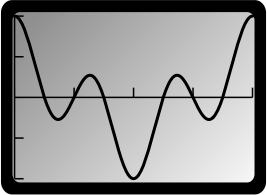
Note: The graph above visually represents the solutions to a trigonometric equation within a specified interval, showing where the function crosses the axis.
Additional info: The examples and explanations above are expanded for clarity and completeness, based on standard precalculus curriculum and the provided outline.
