 Back
BackThe Laws of Sines and Cosines: Solving Triangles and Applications
Study Guide - Smart Notes
 Tailored notes based on your materials, expanded with key definitions, examples, and context.
Non-Right Triangles
The Laws of Sines and Cosines
This section explores the Law of Sines and the Law of Cosines, which are essential tools for solving triangles that are not right triangles. These laws allow us to determine unknown sides and angles in oblique triangles (triangles without a right angle) and have important applications in geometry, trigonometry, and real-world problems.
Law of Sines
Definition: In any triangle with angles A, B, and C opposite sides a, b, and c respectively, the Law of Sines states:
Applications: The Law of Sines is used to solve triangles when given:
Two angles and one side (AAS or ASA)
Two sides and a non-included angle (SSA, the ambiguous case)
Ambiguous Case (SSA): When two sides and a non-included angle are given, there may be zero, one, or two possible triangles. This is known as the ambiguous case.
Example: Solving a Triangle Given Two Angles and a Side (AAS/ASA)
Given two angles and one side, use the Law of Sines to find the unknown sides.
Steps:
Find the third angle using the triangle sum theorem:
Apply the Law of Sines to solve for the unknown sides.
Example: The Ambiguous Case (SSA)
Given two sides and a non-included angle, use the Law of Sines to determine the number of possible triangles and solve for unknowns.
Check if the given information leads to zero, one, or two possible triangles by considering the possible values for the sine function.
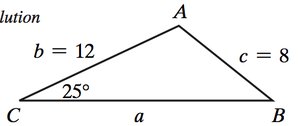
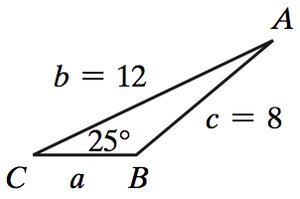
Law of Cosines
Definition: For any triangle with sides a, b, c and opposite angles A, B, C, the Law of Cosines states: Similarly,
Applications: The Law of Cosines is used to solve triangles when given:
Two sides and the included angle (SAS)
All three sides (SSS)
Example: Solving a Triangle (SAS)
Given two sides and the included angle, use the Law of Cosines to find the third side.
Then, use the Law of Sines or Cosines to find the remaining angles.
Area of a Triangle
Formula using two sides and included angle:
Heron's Formula: For a triangle with sides a, b, c and semiperimeter :
Example: Using Heron's Formula
Given sides 10, 12, and 14, compute the semiperimeter and apply Heron's Formula to find the area.
Approximate area: 58.8 square units.
Applications: Solving Real-World Problems
Trigonometric laws are used to solve practical problems, such as finding the height of a pole using angles of elevation and lengths of shadows.
Example: A pole casts a 15-foot shadow down a road sloped at 15°, with the Sun at a 65° angle of elevation. Use triangle laws to find the pole's height.
Law | Formula | When to Use |
|---|---|---|
Law of Sines | AAS, ASA, SSA (ambiguous case) | |
Law of Cosines | SAS, SSS |
Additional info: The ambiguous case (SSA) is unique because it can yield two different triangles, one triangle, or no triangle, depending on the given values. Always check for possible solutions when using the Law of Sines in this scenario.
