 Back
BackThe Unit Circle and Angle Measurement in Precalculus
Study Guide - Smart Notes
 Tailored notes based on your materials, expanded with key definitions, examples, and context.
The Unit Circle
Definition and Properties
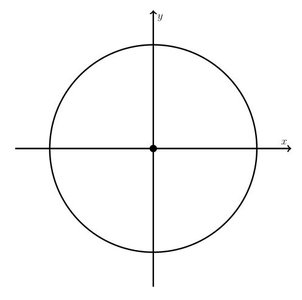
The unit circle is a fundamental concept in precalculus, especially in the study of trigonometric functions. It is defined as a circle with a radius of 1, centered at the origin (0,0) of the Cartesian coordinate plane.
Equation: The equation of the unit circle is .
Center: The center is at the origin, (0,0).
Radius: The radius is always 1.
Applications: The unit circle is used to define the sine, cosine, and tangent functions for all real numbers, and to visualize angles in both degrees and radians.
Coordinate Axes and Symmetry
The unit circle is symmetric about both the x-axis and y-axis. This symmetry is important for understanding the periodic nature of trigonometric functions and their values at key angles.
Quadrants: The circle is divided into four quadrants by the axes.
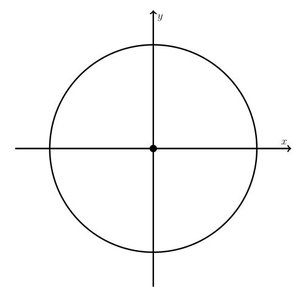
Key Points: The points (1,0), (0,1), (-1,0), and (0,-1) correspond to angles of 0°, 90°, 180°, and 270° respectively.
Angle Measurement: Degrees and Radians
Degrees
Angles can be measured in degrees, where a full rotation around a circle is 360°. Degrees are commonly used in geometry and everyday contexts.
Key Values: 90° (quarter turn), 180° (half turn), 270° (three-quarters), 360° (full turn).
Radians
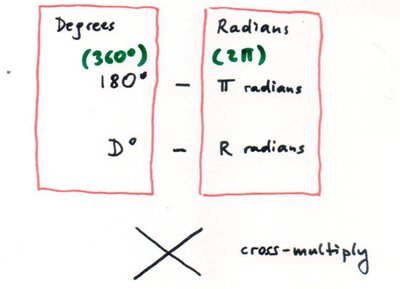
Radians are another way to measure angles, based on the radius of the circle. One full rotation (360°) is equal to radians.
Conversion: radians
Formula: To convert degrees to radians:
Formula: To convert radians to degrees:
Conversion Table
The following table summarizes the relationship between degrees and radians:
Degrees | Radians |
|---|---|
360° | |
180° | |
D° | R radians |
To convert between degrees and radians, use cross-multiplication as shown in the image above.
Summary
The unit circle and the concept of angle measurement in degrees and radians are foundational for understanding trigonometric functions and their applications in precalculus. Mastery of these topics is essential for further study in analytic trigonometry and calculus.
