 Back
The Unit Circle and Special Triangles in Trigonometry
Study Guide - Smart Notes
 Tailored notes based on your materials, expanded with key definitions, examples, and context.
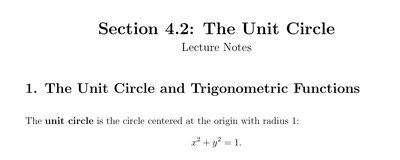
Section 4.2: The Unit Circle
The Unit Circle and Trigonometric Functions
The unit circle is a fundamental concept in trigonometry. It is defined as the circle centered at the origin (0,0) in the coordinate plane with a radius of 1. The equation of the unit circle is:
Any point (x, y) on the unit circle satisfies this equation. The coordinates of points on the unit circle correspond to the cosine and sine of the angle formed with the positive x-axis.
Example: Evaluating Trigonometric Functions on the Unit Circle
For , the corresponding point on the unit circle is (0, 1). Therefore:

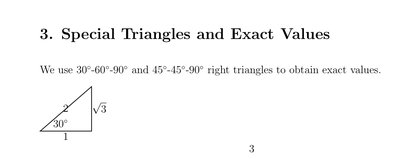
Special Triangles and Exact Values
Exact values of trigonometric functions for common angles can be found using special right triangles: the 30°-60°-90° triangle and the 45°-45°-90° triangle. These triangles have side ratios that allow for the calculation of sine, cosine, and tangent values for these angles without a calculator.
30°-60°-90° triangle: Side lengths are 1 (opposite 30°), (opposite 60°), and 2 (hypotenuse).
45°-45°-90° triangle: Side lengths are 1, 1, and .
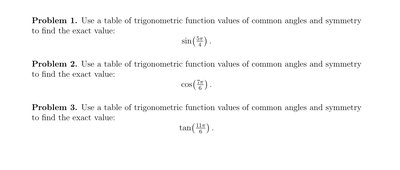
Practice Problems: Using Tables and Symmetry
To find exact values for trigonometric functions at common angles, use tables of values and symmetry properties of the unit circle.
Problem 1: Use a table of trigonometric function values of common angles and symmetry to find the exact value:
Problem 2: Use a table of trigonometric function values of common angles and symmetry to find the exact value:
Problem 3: Use a table of trigonometric function values of common angles and symmetry to find the exact value:
Key Steps:
Identify the reference angle and quadrant for the given angle.
Use the properties of the unit circle to determine the sign (positive or negative) of the function in that quadrant.
Apply the known values from special triangles or trigonometric tables.
Additional info: The use of symmetry and reference angles is essential for evaluating trigonometric functions for angles outside the first quadrant. For example, and .
