 Back
BackThe Unit Circle and the Functions of Trigonometry: Definitions, Properties, and Applications
Study Guide - Smart Notes
 Tailored notes based on your materials, expanded with key definitions, examples, and context.
Chapter 9: The Unit Circle and the Functions of Trigonometry
9.5 Functions and Angles and Fundamental Identities
This section introduces the six trigonometric functions, their definitions using the coordinate plane, and explores their properties, identities, and applications. Understanding these concepts is essential for solving problems involving angles and periodic phenomena.
Trigonometric Functions: Definitions and the Coordinate Plane
Definition of the Six Trigonometric Functions
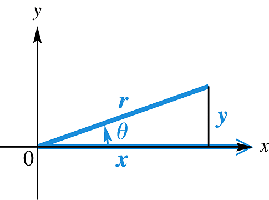
To define the six trigonometric functions, consider an angle θ in standard position (vertex at the origin, initial side along the positive x-axis). Let P(x, y) be any point (other than the origin) on the terminal side of θ. The distance from the origin to P is r, where:
Sine:
Cosine:
Tangent: (x ≠ 0)
Cosecant: (y ≠ 0)
Secant: (x ≠ 0)
Cotangent: (y ≠ 0)
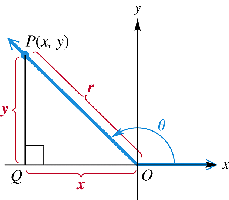
Finding Function Values of an Angle
To find the values of the six trigonometric functions for a given angle, select any point (x, y) on the terminal side (other than the origin) and compute r. The function values are determined using the definitions above. The ratios remain constant for any point on the terminal side due to similar triangles.
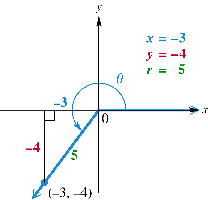
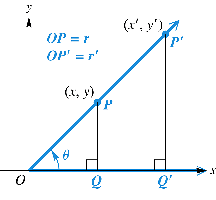
Example: Finding Function Values for a Given Line
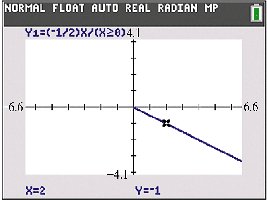
Suppose the terminal side of θ has the equation x + 2y = 0, x ≥ 0. Choose x = 2, then y = -1. The point (2, -1) lies on the terminal side, and:
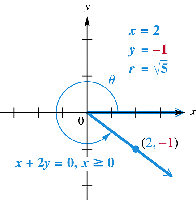
Function Values of Quadrantal Angles
Evaluating Trigonometric Functions at Quadrantal Angles
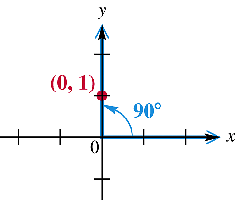
Quadrantal angles are angles whose terminal sides lie along the x- or y-axis (e.g., 0°, 90°, 180°, 270°). For these angles, select a point on the axis (other than the origin) to evaluate the functions.
For θ = 90°, use (0, 1): x = 0, y = 1, r = 1.
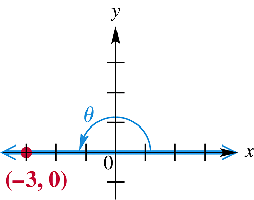
For θ with terminal side through (–3, 0): x = –3, y = 0, r = 3.
Conditions for Undefined Function Values
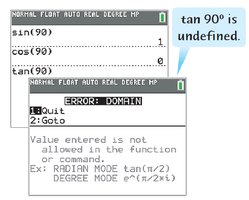
If the terminal side lies along the y-axis, tangent and secant are undefined (division by zero).
If the terminal side lies along the x-axis, cotangent and cosecant are undefined.
Reciprocal and Quotient Identities
Reciprocal Identities
The reciprocal identities relate each trigonometric function to its reciprocal:
and vice versa.
These identities hold for all θ where the denominator is not zero.
Quotient Identities
(cos θ ≠ 0)
(sin θ ≠ 0)
Signs and Ranges of Trigonometric Functions
Signs of Trigonometric Functions in Each Quadrant
The sign of each trigonometric function depends on the quadrant in which the terminal side of θ lies:
Quadrant I: All functions are positive.
Quadrant II: Sine and cosecant are positive; others are negative.
Quadrant III: Tangent and cotangent are positive; others are negative.
Quadrant IV: Cosine and secant are positive; others are negative.
For example, if sin θ > 0 and tan θ < 0, θ must be in Quadrant II.
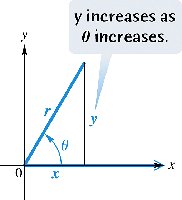
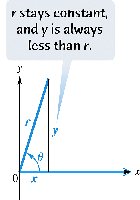
Ranges of Trigonometric Functions
and can take any real value.
or
or
For example, tan θ = 110.47 is possible, but sec θ = 0.6 is impossible.
Pythagorean Identities
Fundamental Pythagorean Identities
These identities are derived from the equation :
Applications: Grade Resistance
Modeling a Downhill Highway Grade
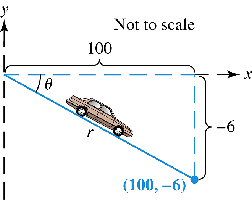
A downhill highway grade can be modeled by a line such as y = –0.06x. The slope represents the grade (–6%). To find the grade resistance for a 3000-pound car, use the point (100, –6) on the terminal side of θ:
Grade resistance is the component of the vehicle's weight acting parallel to the slope:
For a 3000-pound car, the resistance is about 180 pounds downhill.
Summary Table: Trigonometric Function Signs by Quadrant
Quadrant | sin θ | cos θ | tan θ | csc θ | sec θ | cot θ |
|---|---|---|---|---|---|---|
I | + | + | + | + | + | + |
II | + | – | – | + | – | – |
III | – | – | + | – | – | + |
IV | – | + | – | – | + | – |
Key Takeaways
Trigonometric functions are defined using coordinates on the terminal side of an angle in standard position.
Function values can be found for any angle using the definitions and properties of similar triangles.
Quadrantal angles require special attention due to possible undefined values.
Reciprocal, quotient, and Pythagorean identities are fundamental tools for simplifying and solving trigonometric expressions.
Applications such as grade resistance use trigonometric functions to model real-world phenomena.
