 Back
BackThe Unit Circle and the Functions of Trigonometry
Study Guide - Smart Notes
 Tailored notes based on your materials, expanded with key definitions, examples, and context.
Chapter 9.2: The Unit Circle and the Functions of Trigonometry
9.2 The Unit Circle and Its Functions
The unit circle is a fundamental concept in trigonometry, defined as the circle with center at the origin (0,0) and radius one unit. The trigonometric functions, when extended to all real numbers, are called circular functions. To define these functions for any real number s, start at the point (1,0) and measure an arc of length s counterclockwise if s > 0 and clockwise if s < 0.
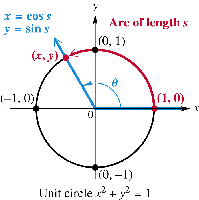
Angles and Arcs: Basic Terminology
On the unit circle, the coordinates of a point corresponding to an arc length s are given by (cos s, sin s). The angle θ in radians is equal to the arc length s for a unit circle.
Circular (Trigonometric) Functions
If (x, y) is the point on the unit circle that corresponds to the real number s, then:
sin s = y
cos s = x
tan s = y / x (undefined when x = 0)
csc s = 1 / y (undefined when y = 0)
sec s = 1 / x (undefined when x = 0)
cot s = x / y (undefined when y = 0)
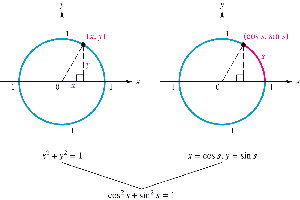
Relationship Between Sine and Cosine
For any real number s, the coordinates (x, y) = (cos s, sin s) satisfy the equation of the unit circle:
Therefore,
This is known as the Pythagorean Identity.
Domains of the Circular Functions
The domains of the six circular functions are as follows (where n is any integer and s is a real number):
Sine and Cosine:
Tangent and Secant:
Cotangent and Cosecant:
For example, tan s and sec s are undefined when x = 0, which occurs at .
Identities Involving Circular Functions
Several important identities hold for all values in the domain of the variable:
If , then
If , then
An identity is a statement that is true for all values in the domain of the variable.
Finding Function Values by Using the Unit Circle
To find the value of a trigonometric function for a given real number s, determine the corresponding point on the unit circle and use the x- or y-coordinate as appropriate.
Example a) s = 0: The point is (1, 0). So, sin 0 = 0, cos 0 = 1, tan 0 = 0, sec 0 = 1, csc 0 is undefined, cot 0 is undefined.
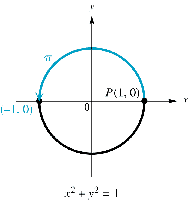
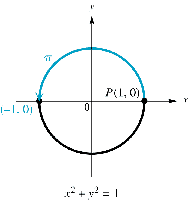
Example b) s = \pi: The point is (–1, 0). So, sin \pi = 0, cos \pi = –1, tan \pi = 0, sec \pi = –1, csc \pi is undefined, cot \pi is undefined.
Example c) s = \frac{3\pi}{2}: The point is (0, –1). So, sin = –1, cos = 0, tan is undefined, sec $\frac{3\pi}{2}$ is undefined, csc $\frac{3\pi}{2}$ = –1, cot $\frac{3\pi}{2}$ = 0.
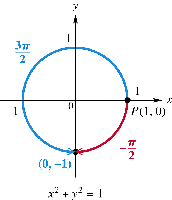
Example d) s = –\frac{\pi}{2}: The point is (0, –1), same as part c.
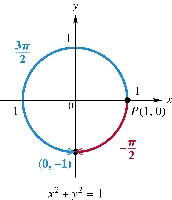
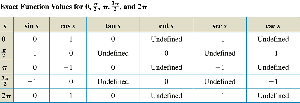
Table: Exact Function Values for
s | sin s | cos s | tan s | cot s | sec s | csc s |
|---|---|---|---|---|---|---|
0 | 0 | 1 | 0 | Undefined | 1 | Undefined |
1 | 0 | Undefined | 0 | Undefined | 1 | |
0 | –1 | 0 | Undefined | –1 | Undefined | |
–1 | 0 | Undefined | 0 | Undefined | –1 | |
0 | 1 | 0 | Undefined | 1 | Undefined |
Using a Calculator to Find Function Values
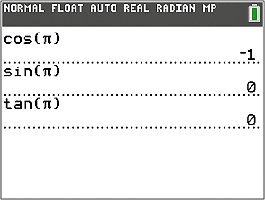
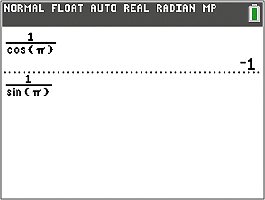
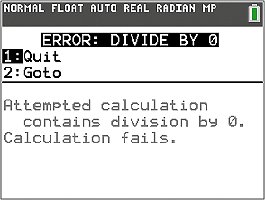
To find trigonometric function values for angles not on the standard unit circle, use a calculator in radian mode. For example, for :
cos() = –1
sin() = 0
tan() = 0
sec() = –1
csc() is undefined
cot() is undefined
Function Values at Multiples of
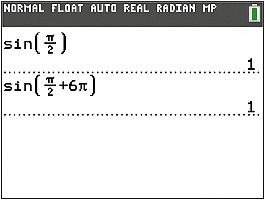
Because the circumference of the unit circle is , any integer multiple of added to s corresponds to the same point as s on the unit circle. Thus, for any integer n:
Signs of Values of Trigonometric Functions
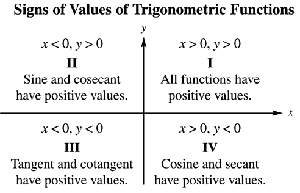
The sign of a trigonometric function depends on the quadrant in which the terminal side of the angle lies:
Quadrant I (x > 0, y > 0): All functions are positive.
Quadrant II (x < 0, y > 0): Sine and cosecant are positive.
Quadrant III (x < 0, y < 0): Tangent and cotangent are positive.
Quadrant IV (x > 0, y < 0): Cosine and secant are positive.
Using Circular Functions to Find the Quadrant
Given a value of s, determine the quadrant by examining the signs of cos s (x-coordinate) and sin s (y-coordinate). For example, if cos s < 0 and sin s > 0, the point is in quadrant II.
Finding the Cosine, Sine, and Quadrant for Arbitrary Angles
For non-standard angles, use a calculator to approximate values. For example, for s = 4.5:
cos 4.5 ≈ –0.2108
sin 4.5 ≈ –0.9775
Since both values are negative, the point lies in quadrant III.
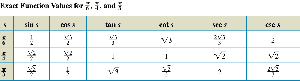
Exact Function Values for , , and
Special angles such as , , and have exact trigonometric values. For example, the line y = x bisects the first quadrant, giving:
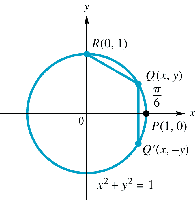
For and :
The Unit Circle with Key Coordinates
The unit circle can be labeled with the coordinates of points corresponding to common angles, which helps in quickly finding exact values for sine and cosine.
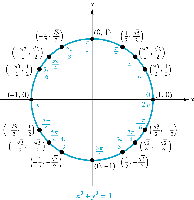
Table: Exact Function Values for , ,
s | sin s | cos s | tan s | cot s | sec s | csc s |
|---|---|---|---|---|---|---|
2 | ||||||
1 | 1 | |||||
2 |
Additional info: The above tables and diagrams are essential for memorizing and understanding the behavior of trigonometric functions on the unit circle, which is foundational for all further study in trigonometry and calculus.
