 Back
BackTransformations of Functions: Precalculus Study Guide
Study Guide - Smart Notes
 Tailored notes based on your materials, expanded with key definitions, examples, and context.
Chapter 1: Graphs and Functions
1.7 Transformations of Functions
Transformations are operations that alter the graph of a function in predictable ways. Understanding these transformations is essential for graphing and analyzing functions in precalculus. The main types of transformations include shifts, reflections, stretches, and compressions.
Definition of Transformations
Transformation: If a new function is formed by performing certain operations on a given function f, then the graph of the new function is called a transformation of the graph of f.
Vertical Shifts
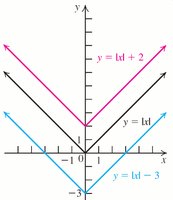
Vertical shifts move the graph of a function up or down without changing its shape.
Upward Shift: The graph of g(x) = f(x) + d is the graph of y = f(x) shifted d units up.
Downward Shift: The graph of h(x) = f(x) - d is the graph of y = f(x) shifted d units down.
Correspondence: If (x, y) is a point on y = f(x), then (x, y + d) is on g(x) = f(x) + d and (x, y - d) is on h(x) = f(x) - d.
Example: For f(x) = |x|, g(x) = |x| + 2, and h(x) = |x| - 3, the graphs are shifted vertically.
Horizontal Shifts
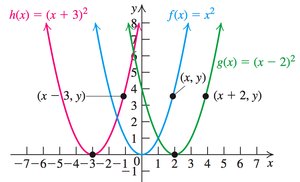
Horizontal shifts move the graph left or right.
Right Shift: The graph of y = f(x - c) is the graph of y = f(x) shifted c units to the right.
Left Shift: The graph of y = f(x + c) is the graph of y = f(x) shifted c units to the left.
Correspondence: If (x, y) is a point on y = f(x), then (x + c, y) is on y = f(x - c) and (x - c, y) is on y = f(x + c).
Example: For f(x) = x^2, g(x) = (x - 2)^2, and h(x) = (x + 3)^2, the graphs are shifted horizontally.
Combined Vertical and Horizontal Shifts
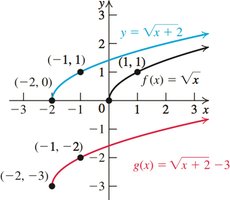
Functions can be shifted both vertically and horizontally by combining the above transformations.
General Form: y = f(x ± c) ± d shifts the graph horizontally by c units and vertically by d units.
Domain and Range: Shifts may affect the domain and range of the function.
Example: Shifting y = \sqrt{x} horizontally and vertically.
Reflections
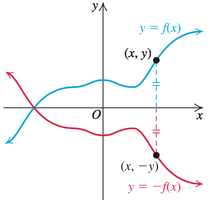
Reflections flip the graph over a specified axis.
Reflection about the x-axis: The graph of g(x) = -f(x) is a reflection of y = f(x) about the x-axis. If (x, y) is on f, then (x, -y) is on g.
Reflection about the y-axis: The graph of g(x) = f(-x) is a reflection of y = f(x) about the y-axis. If (x, y) is on f, then (-x, y) is on g.
Combining Transformations
Multiple transformations can be applied sequentially to a function. The order of operations matters and affects the final graph.
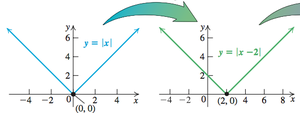
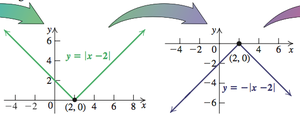
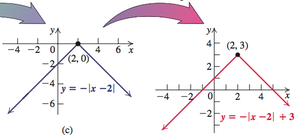
Example: To graph y = -|x - 2| + 3 from y = |x|:
Shift right 2 units: y = |x - 2|
Reflect about x-axis: y = -|x - 2|
Shift up 3 units: y = -|x - 2| + 3
Absolute Value Transformations
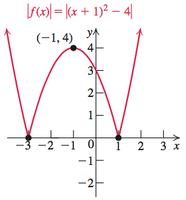
Taking the absolute value of a function reflects any portion below the x-axis above the x-axis.
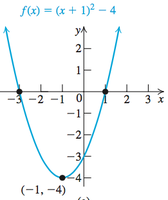
Example: For f(x) = (x + 1)^2 - 4, the graph of y = |f(x)| is unchanged for y \geq 0 and reflected for y < 0.
Vertical Stretching and Compressing
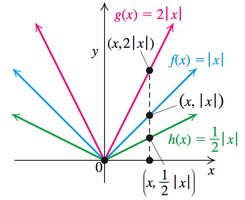
Vertical stretching or compressing changes the steepness of the graph by multiplying the y-coordinates by a constant.
Vertical Stretch: If a > 1, g(x) = a f(x) stretches the graph away from the x-axis.
Vertical Compression: If 0 < a < 1, g(x) = a f(x) compresses the graph toward the x-axis.
Reflection: If a < 0, first stretch/compress, then reflect about the x-axis.
Example: For f(x) = |x|, g(x) = 2|x| (stretch), h(x) = \frac{1}{2}|x| (compression).
Horizontal Stretching and Compressing
Horizontal stretching or compressing changes the width of the graph by multiplying the x-coordinates by a constant.
Horizontal Stretch: If 0 < b < 1, g(x) = f(bx) stretches the graph away from the y-axis.
Horizontal Compression: If b > 1, g(x) = f(bx) compresses the graph toward the y-axis.
Reflection: If b < 0, first stretch/compress, then reflect about the y-axis.
Multiple Transformations Example
Applying several transformations in sequence can produce complex graphs.
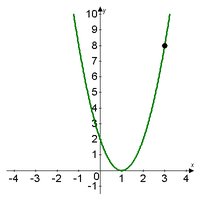
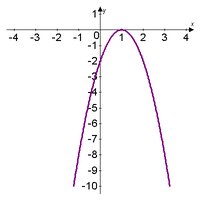
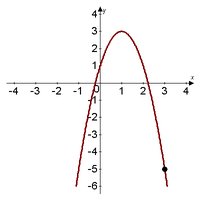
Example: For f(x) = -2(x - 1)^2 + 3:
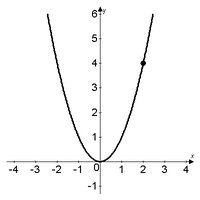
Start with y = x^2 (basic function).
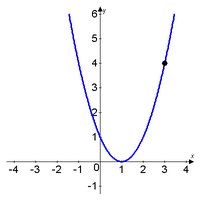
Shift right 1 unit: y = (x - 1)^2.
Stretch vertically by 2: y = 2(x - 1)^2.
Reflect about x-axis: y = -2(x - 1)^2.
Shift up 3 units: y = -2(x - 1)^2 + 3.
Application: Poiseuille’s Law for Arterial Blood Flow
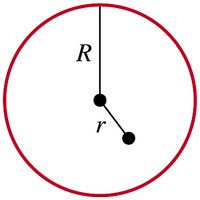
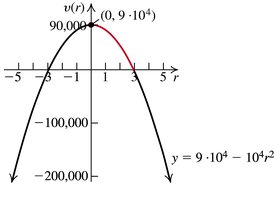
Transformations are used in modeling real-world phenomena. Poiseuille’s Law describes blood flow velocity in an artery as a function of distance from the center.
Formula: v(r) = c(R^2 - r^2), where c is a constant, R is the artery radius, and r is the distance from the center.
Transformations: Start with y = r^2, stretch vertically, reflect about x-axis, and shift up.
Physical Meaning: Velocity decreases from the center to the wall, ceasing at r = R.
Summary Table: Types of Transformations
Transformation | Equation | Effect |
|---|---|---|
Vertical Shift | Up units | |
Vertical Shift | Down units | |
Horizontal Shift | Right units | |
Horizontal Shift | Left units | |
Reflection x-axis | Flip over x-axis | |
Reflection y-axis | Flip over y-axis | |
Vertical Stretch | Stretch if , compress if | |
Horizontal Stretch | Stretch if , compress if |
