 Back
Transformations of Functions: Precalculus Study Notes
Study Guide - Smart Notes
 Tailored notes based on your materials, expanded with key definitions, examples, and context.
Transformations of Functions
Overview of Function Transformations
Understanding how to transform functions is essential for graphing and analyzing mathematical models in precalculus. Transformations allow us to modify parent functions to create new functions by shifting, stretching, shrinking, or reflecting their graphs.
Parent Function: The basic form of a function, such as y = f(x), before any transformations are applied.
Key Points: Specific points on the parent function used to track changes during transformations.
Types of Transformations
There are four main types of transformations applied to functions:
Horizontal Shifts: Move the graph left or right by adding or subtracting a value to the x-coordinate.
Left:
Right:
Vertical Shifts: Move the graph up or down by adding or subtracting a value to the y-coordinate.
Up:
Down:
Vertical Stretch/Shrink: Multiply the y-coordinates by a constant a.
Stretch:
Shrink:
General form:
Reflection: Flip the graph over the x-axis or y-axis.
Over x-axis:
Over y-axis:
Transformation Chart
The following table summarizes the main transformations:
Transformation | Equation | Effect |
|---|---|---|
Horizontal Shift Left | Shift left by h units | |
Horizontal Shift Right | Shift right by h units | |
Vertical Shift Up | Shift up by k units | |
Vertical Shift Down | Shift down by k units | |
Vertical Stretch | , | Stretches graph vertically |
Vertical Shrink | , | Shrinks graph vertically |
Reflection over x-axis | Flips graph over x-axis | |
Reflection over y-axis | Flips graph over y-axis |
Examples of Transformations
Let's apply transformations to specific functions and analyze their effects.
Example 1: Graphing Functions Using Transformations
a.
Apply horizontal shift, vertical shift, and possibly stretch/shrink.
Domain: All real numbers
Range: All real numbers
b.
Apply reflection, horizontal shift, and vertical shift.
Domain: All real numbers
Range: All real numbers
c.
Apply vertical stretch, reflection, horizontal and vertical shifts.
Domain: All real numbers
Range: All real numbers
d.
Apply vertical shift and horizontal shift.
Domain: All real numbers
Range: All real numbers
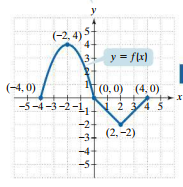
Example 2: Composite Transformations
Given the graph of , graph by applying the following transformations:
Horizontal shift right by 3 units
Vertical stretch by factor of 12
Reflection over x-axis
Vertical shift down by 2 units
Example 3: Finding the Equation from a Transformed Graph
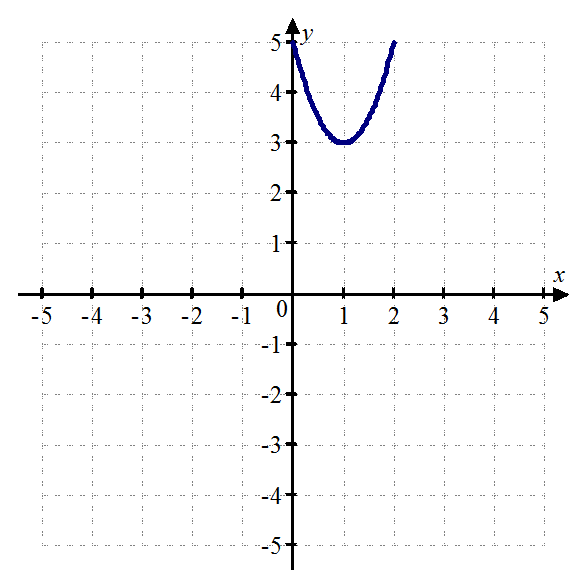
If is obtained from through a sequence of transformations, and the graph shows an upward opening parabola with vertex at (1, 3), the equation for $g$ can be found by:
Identifying the vertex form:
Here, ,
Equation:
Practice Problems
1.
Vertical shift up by 1 unit
Domain: All real numbers
Range:
2.
Vertical stretch, reflection, and vertical shift
Domain: All real numbers
Range: All real numbers
Summary Table: Transformation Effects
Transformation | How to Apply | Result |
|---|---|---|
Horizontal Shift | Add/subtract to x | Moves graph left/right |
Vertical Shift | Add/subtract to y | Moves graph up/down |
Stretch/Shrink | Multiply y by a | Stretches/shrinks vertically |
Reflection | Change sign of x or y | Flips graph over axis |
Additional info: The notes emphasize the importance of knowing parent functions and their key points for successful graphing. Practice problems reinforce the application of transformations and domain/range analysis.
