 Back
Trigonometric Functions: Graphs, Properties, and Transformations
Study Guide - Smart Notes
 Tailored notes based on your materials, expanded with key definitions, examples, and context.
Trigonometric Functions and Their Graphs
Overview of the Six Basic Trigonometric Functions
Trigonometric functions are fundamental in Precalculus, describing periodic phenomena and relationships in geometry. The six basic trigonometric functions are sine (sin), cosine (cos), tangent (tan), cosecant (csc), secant (sec), and cotangent (cot). Each function has unique properties, domains, ranges, and periodic behavior.
Sine (sin) and cosine (cos) are periodic with period .
Tangent (tan) and cotangent (cot) are periodic with period .
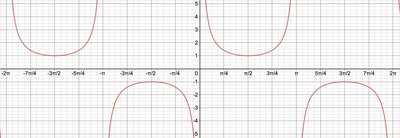
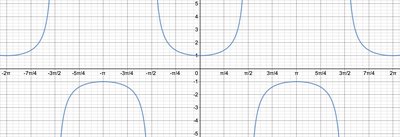
Cosecant (csc) and secant (sec) are reciprocals of sine and cosine, respectively.
Graphs of Reciprocal Trigonometric Functions
The reciprocal trigonometric functions—cosecant and secant—are defined as follows:
These functions have vertical asymptotes where their denominators are zero (i.e., where sine or cosine equals zero). Their graphs exhibit repeating patterns and are not defined at these points.
Cosecant (csc): Period , asymptotes at where is an integer.
Secant (sec): Period , asymptotes at where is an integer.
Graphs of Tangent and Cotangent Functions
The tangent and cotangent functions are defined as:
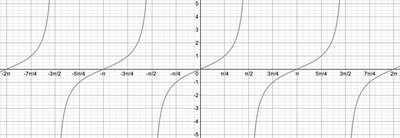
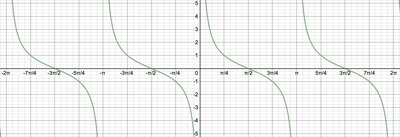
These functions have vertical asymptotes where their denominators are zero. Their graphs are periodic and pass through the origin (for tangent) or have undefined values at the origin (for cotangent).
Tangent (tan): Period , asymptotes at .
Cotangent (cot): Period , asymptotes at .
Summary Table: Properties of Trigonometric Functions
The following table summarizes the main properties of the six trigonometric functions:
Function | Domain | Range | Period | Asymptotes |
|---|---|---|---|---|
sin(x) | None | |||
cos(x) | None | |||
tan(x) | except | |||
csc(x) | except | |||
sec(x) | except | |||
cot(x) | except |
Applications and Transformations
Understanding the graphs and properties of trigonometric functions is essential for solving equations, modeling periodic phenomena, and analyzing transformations such as shifts, stretches, and reflections. These concepts are foundational for further study in calculus and physics.
