 Back
BackTrigonometric Functions of Any Angle
Study Guide - Smart Notes
 Tailored notes based on your materials, expanded with key definitions, examples, and context.
Trigonometric Functions of Any Angle
Definitions of Trigonometric Functions of Any Angle
Trigonometric functions can be defined for any angle, not just acute angles in right triangles. For an angle θ in standard position, with its terminal side passing through the point P = (x, y) and distance r = \sqrt{x^2 + y^2} from the origin, the six trigonometric functions are defined as:
Sine:
Cosine:
Tangent: , x ≠ 0
Cosecant: , y ≠ 0
Secant: , x ≠ 0
Cotangent: , y ≠ 0
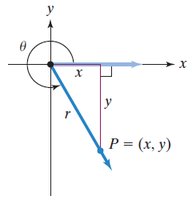
Example: If the terminal side of θ passes through (3, 4), then , so , , , etc.
Trigonometric Functions of Quadrantal Angles
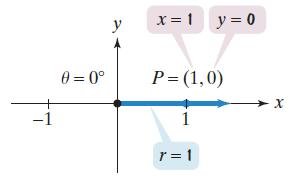
Quadrantal angles are angles whose terminal sides lie on the x- or y-axis (e.g., 0°, 90°, 180°, 270°, or their radian equivalents). The trigonometric functions for these angles can be evaluated by considering the coordinates of the point where the terminal side intersects the unit circle.
At θ = 0° (or 0 radians), the point is (1, 0), so , , .
At θ = 90° (or radians), the point is (0, 1), so , , is undefined.
Similar reasoning applies for 180°, 270°, and 360°.
The Signs of the Trigonometric Functions
The sign of a trigonometric function depends on the quadrant in which the terminal side of the angle lies:
Quadrant I: All trigonometric functions are positive.
Quadrant II: Only sine and cosecant are positive.
Quadrant III: Only tangent and cotangent are positive.
Quadrant IV: Only cosine and secant are positive.
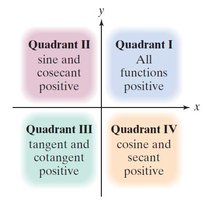
Example: If θ is in Quadrant III, then is negative, is negative, but is positive.
Reference Angles
A reference angle is the acute angle formed by the terminal side of θ and the x-axis. Reference angles are always positive and less than 90° (or radians). They are used to evaluate trigonometric functions for any angle by relating them to the corresponding acute angle in the first quadrant.
For θ in Quadrant I: Reference angle = θ
For θ in Quadrant II: Reference angle = 180° – θ (or )
For θ in Quadrant III: Reference angle = θ – 180° (or )
For θ in Quadrant IV: Reference angle = 360° – θ (or )
Example: The reference angle for 210° is 210° – 180° = 30°.
Using Reference Angles to Evaluate Trigonometric Functions
To evaluate a trigonometric function for any angle:
Find the reference angle for θ.
Evaluate the trigonometric function for the reference angle.
Determine the correct sign based on the quadrant in which θ lies.
Example: To find :
Reference angle = 180° – 150° = 30°
150° is in Quadrant II, where sine is positive, so
Procedure Summary:
Identify the quadrant of θ.
Find the reference angle.
Evaluate the function for the reference angle.
Apply the correct sign.
Additional info: For angles greater than 360° (or ) or less than –360° (or –$2\pi$), subtract or add multiples of 360° (or $2\pi$) to find a coterminal angle between 0° and 360° (or 0 and $2\pi$), then proceed as above.
