 Back
BackTrigonometric Functions of Any Angle: Definitions, Properties, and Applications
Study Guide - Smart Notes
 Tailored notes based on your materials, expanded with key definitions, examples, and context.
Trigonometric Functions of Any Angle
Definition and General Formulas
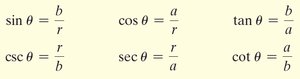
Trigonometric functions can be defined for any angle, not just acute angles in right triangles. For an angle θ in standard position, and a point (a, b) (other than the origin) on its terminal side, the six trigonometric functions are defined as follows, where r is the distance from the origin to (a, b):
sin θ = b / r
cos θ = a / r
tan θ = b / a
csc θ = r / b
sec θ = r / a
cot θ = a / b
where and denominators must not be zero.
Example: Finding Trigonometric Functions from a Point
Given a point (12, –5) on the terminal side of angle θ, find the exact values of all six trigonometric functions:
Calculate
Coterminal Angles
Definition and Properties
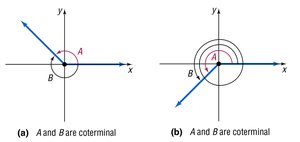
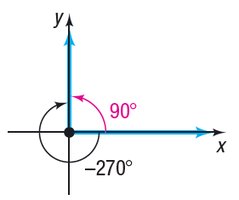
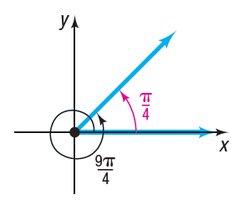
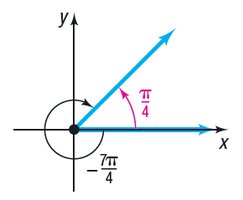
Coterminal angles are angles in standard position that share the same terminal side. Two angles θ and φ are coterminal if their difference is a multiple of 360° (or 2π radians):
and (for integer k) are coterminal.
Examples: Finding Trigonometric Values Using Coterminal Angles
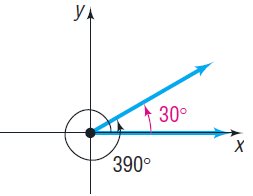
To find , subtract 360°: . So, .
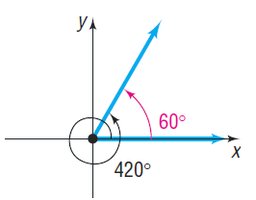
To find , subtract 360°: . So, .
For negative angles, add 360° (or 2π): . So, .
For radian measures, add or subtract as needed. For example, , so .
Signs of Trigonometric Functions in Quadrants
Determining Signs by Quadrant
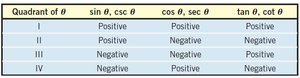
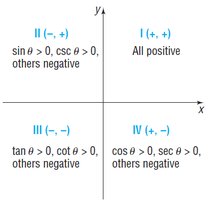
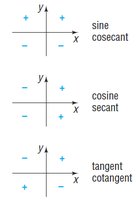
The sign of each trigonometric function depends on the quadrant in which the terminal side of the angle lies:
Quadrant of θ | sin θ, csc θ | cos θ, sec θ | tan θ, cot θ |
|---|---|---|---|
I | Positive | Positive | Positive |
II | Positive | Negative | Negative |
III | Negative | Negative | Positive |
IV | Negative | Positive | Negative |
Example: Determining the Quadrant
If and , then θ is in quadrant IV, since only in quadrant IV is sine negative and cosine positive.
Reference Angles
Definition and Properties
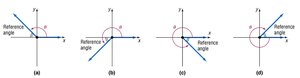
A reference angle is the acute angle formed by the terminal side of θ and the x-axis. It is always between 0° and 90° (or 0 and radians).
Finding Reference Angles
Quadrant I: Reference angle is θ itself.
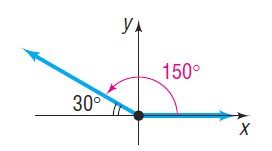
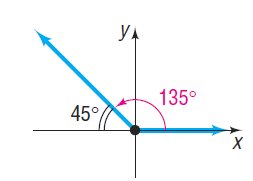
Quadrant II: Reference angle is or .
Quadrant III: Reference angle is or .
Quadrant IV: Reference angle is or .
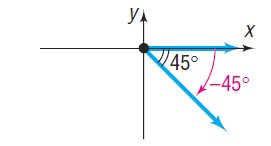
Examples: Reference Angles
Reference angle for 150° is 30°.
Reference angle for –45° is 45°.
Reference angle for is .
Reference angle for is .
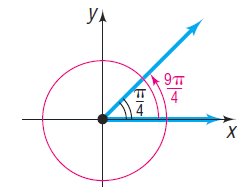
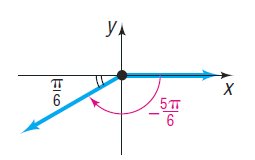
Using Reference Angles to Find Trigonometric Values
The value of a trigonometric function for any angle θ is equal to the value of the function at its reference angle, up to a sign determined by the quadrant:
The sign depends on the quadrant in which θ lies.
Examples: Using Reference Angles
: Reference angle is 45°, and cosine is negative in quadrant II, so .
: Reference angle is 60°, and tangent is positive in quadrant III, so .
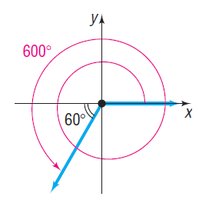
Summary: Steps for Finding Trigonometric Values of Any Angle
If the angle is a quadrantal angle (multiple of 90°), use the definition directly.
If the angle is not quadrantal:
Find the reference angle α.
Find the value of the trigonometric function at α.
Adjust the sign based on the quadrant.
Application: Finding All Trigonometric Functions Given One Value
If you know one trigonometric function and the quadrant, you can find all others using the Pythagorean identity and sign rules. For example, if and , θ is in quadrant II. Construct a right triangle with sides 1 and 3, hypotenuse , and assign signs according to the quadrant.
Additional info: The above notes are based on standard precalculus curriculum and include all major concepts from the provided materials, with relevant images included only where they directly support the explanation.
