 Back
BackTrigonometric Functions: The Unit Circle and Their Properties
Study Guide - Smart Notes
 Tailored notes based on your materials, expanded with key definitions, examples, and context.
Chapter 4: Trigonometric Functions
4.2 Trigonometric Functions: The Unit Circle
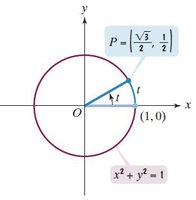
The unit circle is a fundamental concept in trigonometry, providing a geometric framework for defining the six trigonometric functions. It is a circle with a radius of 1 centered at the origin of the coordinate plane. The position of a point on the unit circle corresponds to an angle measured from the positive x-axis.
The Unit Circle
The equation of the unit circle is .
Any point on the unit circle corresponds to an angle (in radians) measured from the positive x-axis.
The coordinates represent the cosine and sine of the angle , respectively.
The Six Trigonometric Functions
The six trigonometric functions are defined using the coordinates of a point on the unit circle:
Sine:
Cosine:
Tangent: ,
Cosecant: ,
Secant: ,
Cotangent: ,
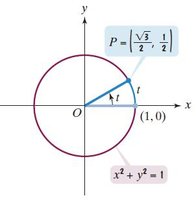
Example: Finding Values of the Trigonometric Functions
Suppose is a point on the unit circle corresponding to angle .
The Domain and Range of the Sine and Cosine Functions
Domain: All real numbers,
Range:
Even and Odd Trigonometric Functions
Trigonometric functions can be classified as even or odd based on their symmetry properties:
Even functions: ,
Odd functions: , , ,
Fundamental Trigonometric Identities
Several identities are fundamental to trigonometry and are used to simplify expressions and solve equations:
Pythagorean Identities:
Definition of a Periodic Function
A function is periodic if there exists a positive number such that for all in the domain of . The smallest such is called the period of .
Periodic Properties of the Sine and Cosine Functions
The period of sine and cosine is .
Periodic Properties of the Tangent and Cotangent Functions
The period of tangent and cotangent is .
Repetitive Behavior of the Sine, Cosine, and Tangent Functions
The graphs of sine, cosine, and tangent functions repeat their values at regular intervals, reflecting their periodic nature.
Using a Calculator to Evaluate Trigonometric Functions
Set the calculator to the correct mode: degrees or radians (for the unit circle, use radians).
Use the SIN, COS, and TAN keys to evaluate trigonometric functions.
Consult your calculator's manual for specific instructions.
Example:
Example:
