 Back
BackTrigonometric Identities, Exact Values, and Inverse Functions – Precalculus Study Guidance
Study Guide - Smart Notes
 Tailored notes based on your materials, expanded with key definitions, examples, and context.
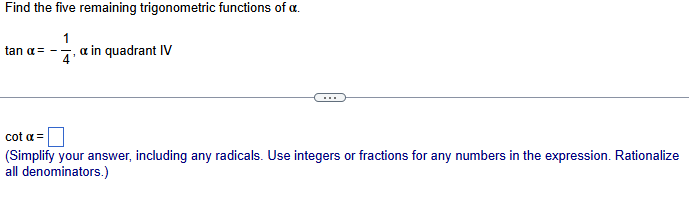
Q1. Find the five remaining trigonometric functions of \( \alpha \), given \( \tan \alpha = -\frac{1}{4} \), \( \alpha \) in quadrant IV.
Background
Topic: Trigonometric Functions and Identities
This question tests your understanding of how to find all six trigonometric functions given one function value and the quadrant of the angle.
Key Terms and Formulas:
\( \tan \alpha = \frac{\text{opposite}}{\text{adjacent}} \)
\( \cot \alpha = \frac{1}{\tan \alpha} \)
Pythagorean identity: \( \sin^2 \alpha + \cos^2 \alpha = 1 \)
Signs of trig functions in quadrant IV: cosine and secant are positive; sine, cosecant, tangent, and cotangent are negative.
Step-by-Step Guidance
Assign values based on \( \tan \alpha = -\frac{1}{4} \): let the opposite side be \( -1 \) and the adjacent side be \( 4 \).
Use the Pythagorean theorem to find the hypotenuse: \( r = \sqrt{(-1)^2 + 4^2} \).
Write expressions for \( \sin \alpha = \frac{\text{opposite}}{r} \) and \( \cos \alpha = \frac{\text{adjacent}}{r} \), considering the signs in quadrant IV.
Set up the reciprocal functions: \( \csc \alpha = \frac{1}{\sin \alpha} \), \( \sec \alpha = \frac{1}{\cos \alpha} \), \( \cot \alpha = \frac{1}{\tan \alpha} \).
Try solving on your own before revealing the answer!
Final Answer:
\( \cot \alpha = -4 \), \( \sin \alpha = -\frac{1}{\sqrt{17}} \), \( \cos \alpha = \frac{4}{\sqrt{17}} \), \( \csc \alpha = -\frac{\sqrt{17}}{1} \), \( \sec \alpha = \frac{\sqrt{17}}{4} \)
All values are found using the triangle and the signs for quadrant IV.
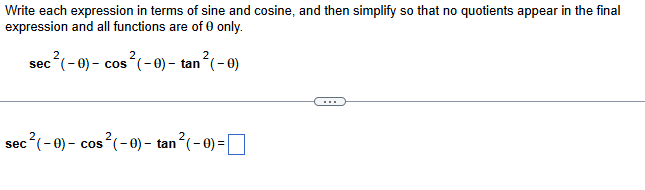
Q2. Write each expression in terms of sine and cosine, and then simplify: \( \sec^2(-\theta) - \cos^2(-\theta) - \tan^2(-\theta) \)
Background
Topic: Trigonometric Identities and Simplification
This question tests your ability to rewrite trigonometric expressions using basic identities and to simplify them.
Key Terms and Formulas:
\( \sec \theta = \frac{1}{\cos \theta} \)
\( \tan \theta = \frac{\sin \theta}{\cos \theta} \)
Even-odd identities: \( \cos(-\theta) = \cos \theta \), \( \sin(-\theta) = -\sin \theta \), \( \tan(-\theta) = -\tan \theta \)
Step-by-Step Guidance
Rewrite each function in terms of sine and cosine, using the even-odd properties for negative angles.
Express \( \sec^2(-\theta) \) as \( \frac{1}{\cos^2 \theta} \), \( \cos^2(-\theta) \) as \( \cos^2 \theta \), and \( \tan^2(-\theta) \) as \( \tan^2 \theta \).
Substitute \( \tan^2 \theta = \frac{\sin^2 \theta}{\cos^2 \theta} \) into the expression.
Combine all terms over a common denominator to simplify the expression.
Try solving on your own before revealing the answer!
Final Answer:
\( \sec^2(-\theta) - \cos^2(-\theta) - \tan^2(-\theta) = \frac{1 - \sin^2 \theta}{\cos^2 \theta} - \cos^2 \theta \)
After simplification, you should get a result in terms of sine and cosine only.
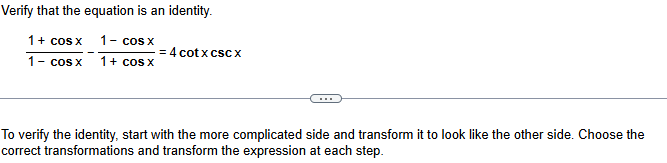
Q3. Verify that the equation is an identity: \( \frac{1 + \cos x}{1 - \cos x} \cdot \frac{1 - \cos x}{1 + \cos x} = 4 \cot x \csc x \)
Background
Topic: Trigonometric Identities
This question tests your ability to verify trigonometric identities by transforming one side of the equation to match the other.
Key Terms and Formulas:
\( \cot x = \frac{\cos x}{\sin x} \)
\( \csc x = \frac{1}{\sin x} \)
Algebraic manipulation and factoring
Step-by-Step Guidance
Start with the more complicated side (the left side) and multiply the numerators and denominators.
Simplify the product: \( (1 + \cos x)(1 - \cos x) = 1 - \cos^2 x \).
Recall that \( 1 - \cos^2 x = \sin^2 x \).
Express the result as a single fraction and compare to the right side.
Try solving on your own before revealing the answer!
Final Answer:
After simplification, both sides are equal, confirming the identity.
The key is recognizing the Pythagorean identity and expressing everything in terms of sine and cosine.
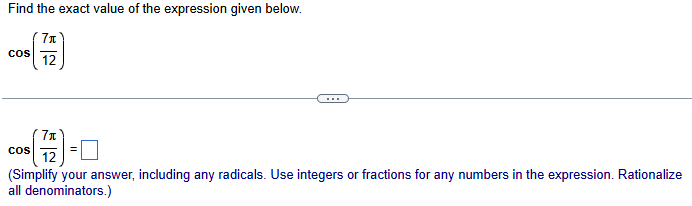
Q4. Find the exact value of \( \cos \left( \frac{7\pi}{12} \right) \)
Background
Topic: Exact Trigonometric Values and Angle Sum/Difference Identities
This question tests your ability to use sum or difference identities to find the exact value of a trigonometric function for a non-standard angle.
Key Terms and Formulas:
Angle sum identity: \( \cos(A + B) = \cos A \cos B - \sin A \sin B \)
Common angles: \( \frac{\pi}{3}, \frac{\pi}{4}, \frac{\pi}{6} \)
Step-by-Step Guidance
Express \( \frac{7\pi}{12} \) as a sum or difference of two common angles (e.g., \( \frac{7\pi}{12} = \frac{3\pi}{12} + \frac{4\pi}{12} = \frac{\pi}{4} + \frac{\pi}{3} \)).
Apply the cosine sum identity: \( \cos(A + B) = \cos A \cos B - \sin A \sin B \).
Substitute the exact values for \( \cos \frac{\pi}{4}, \cos \frac{\pi}{3}, \sin \frac{\pi}{4}, \sin \frac{\pi}{3} \).
Simplify the resulting expression, combining like terms and rationalizing denominators if needed.
Try solving on your own before revealing the answer!
Final Answer:
\( \cos \left( \frac{7\pi}{12} \right) = \frac{\sqrt{6} - \sqrt{2}}{4} \)
This uses the sum identity and the exact values for the standard angles.
