 Back
BackTrigonometric Identities, Inverse Functions, and Equations – Study Guide and Review
Study Guide - Smart Notes
 Tailored notes based on your materials, expanded with key definitions, examples, and context.
Trigonometric Identities, Inverse Functions, and Equations
Key Trigonometric Functions
Trigonometric functions relate angles of a triangle to the ratios of its sides and are fundamental in the study of periodic phenomena. The six basic trigonometric functions are sine, cosine, tangent, cosecant, secant, and cotangent.
Sine (sin):
Cosine (cos):
Tangent (tan):
Cosecant (csc):
Secant (sec):
Cotangent (cot):
These functions are defined for all real numbers using the unit circle, where the angle is measured from the positive x-axis.
Inverse Trigonometric Functions
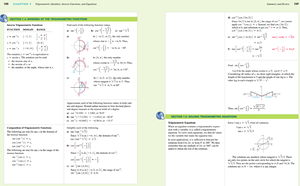
Inverse trigonometric functions allow us to determine the angle that corresponds to a given trigonometric value. The principal values are restricted to ensure the function is one-to-one.
Arcsine (sin-1 or asin):
Arccosine (cos-1 or acos):
Arctangent (tan-1 or atan):
For example, because .
Trigonometric Identities
Trigonometric identities are equations involving trigonometric functions that are true for all values of the variable where both sides are defined. They are essential tools for simplifying expressions and solving equations.
Pythagorean Identities:
Sum and Difference Formulas:
Double-Angle Formulas:
These identities are used to simplify expressions and solve trigonometric equations.
Solving Trigonometric Equations
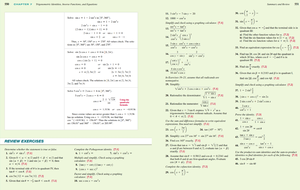
To solve trigonometric equations, use algebraic techniques and trigonometric identities to isolate the variable. Solutions may be restricted to a specific interval, such as .
Example: Solve for in .
Solution:
Graphs of Trigonometric Functions
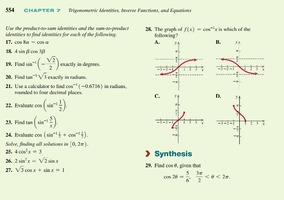
Understanding the graphs of trigonometric functions is crucial for analyzing periodic behavior. The basic sine and cosine functions have amplitude 1, period , and oscillate between -1 and 1.
Sine graph: Starts at 0, rises to 1 at , returns to 0 at , falls to -1 at , and returns to 0 at .
Cosine graph: Starts at 1, falls to 0 at , to -1 at , returns to 0 at , and to 1 at .
Applications of Trigonometric Equations
Trigonometric equations are used to model periodic phenomena such as sound waves, light waves, and tides. They are also used in geometry to solve for unknown sides or angles in triangles.
Example: The height of a point on a Ferris wheel can be modeled as , where is the radius, is the angular speed, and is the phase shift.
Summary Table: Key Trigonometric Identities
Identity | Formula |
|---|---|
Pythagorean | |
Sum Formula (Sine) | |
Difference Formula (Cosine) | |
Double Angle (Sine) | |
Double Angle (Cosine) |
Practice and Review
To master these concepts, practice solving trigonometric equations, proving identities, and graphing trigonometric functions. Use the summary table as a reference for common identities.
