 Back
BackTrigonometry of Acute Angles: Right Triangle Trigonometry and Applications
Study Guide - Smart Notes
 Tailored notes based on your materials, expanded with key definitions, examples, and context.
Trigonometric Functions of Acute Angles
Introduction to Right Triangle Trigonometry
Right triangle trigonometry is a foundational topic in precalculus, focusing on the relationships between the angles and sides of right triangles. These relationships are described using six trigonometric functions, which are essential for solving geometric and real-world problems involving triangles.
Standard Position of an Angle
An acute angle is an angle less than 90 degrees. In standard position, one ray of the angle lies along the positive x-axis, and the other ray extends into the first quadrant. This setup is commonly used to define trigonometric functions based on the coordinates of points on the terminal side of the angle.
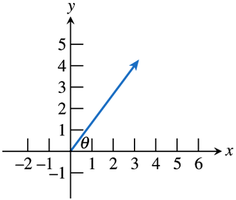
Definition of Trigonometric Functions in a Right Triangle
Given a right triangle with an acute angle \( \theta \), the six trigonometric functions are defined as ratios of the sides of the triangle:
Sine: \( \sin \theta = \frac{\text{opposite}}{\text{hypotenuse}} \)
Cosine: \( \cos \theta = \frac{\text{adjacent}}{\text{hypotenuse}} \)
Tangent: \( \tan \theta = \frac{\text{opposite}}{\text{adjacent}} \)
Cosecant: \( \csc \theta = \frac{\text{hypotenuse}}{\text{opposite}} \)
Secant: \( \sec \theta = \frac{\text{hypotenuse}}{\text{adjacent}} \)
Cotangent: \( \cot \theta = \frac{\text{adjacent}}{\text{opposite}} \)
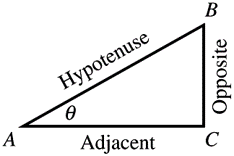
Special Right Triangles and Their Trigonometric Values
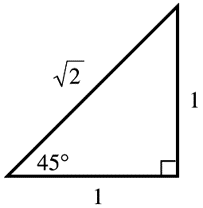
45-45-90 Triangle
The 45-45-90 triangle is an isosceles right triangle where the two legs are congruent. The ratios of the sides are always 1:1:\( \sqrt{2} \). This triangle is used to find exact values of trigonometric functions for 45° angles.
\( \sin 45^\circ = \frac{1}{\sqrt{2}} = \frac{\sqrt{2}}{2} \)
\( \cos 45^\circ = \frac{1}{\sqrt{2}} = \frac{\sqrt{2}}{2} \)
\( \tan 45^\circ = 1 \)
\( \csc 45^\circ = \sqrt{2} \)
\( \sec 45^\circ = \sqrt{2} \)
\( \cot 45^\circ = 1 \)
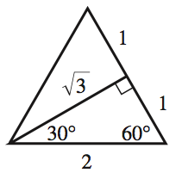
30-60-90 Triangle
The 30-60-90 triangle is a special right triangle with side ratios 1: \( \sqrt{3} \): 2. It is used to find exact values of trigonometric functions for 30° and 60° angles.
\( \sin 30^\circ = \frac{1}{2} \), \( \sin 60^\circ = \frac{\sqrt{3}}{2} \)
\( \cos 30^\circ = \frac{\sqrt{3}}{2} \), \( \cos 60^\circ = \frac{1}{2} \)
\( \tan 30^\circ = \frac{1}{\sqrt{3}} = \frac{\sqrt{3}}{3} \), \( \tan 60^\circ = \sqrt{3} \)
\( \csc 30^\circ = 2 \), \( \csc 60^\circ = \frac{2}{\sqrt{3}} = \frac{2\sqrt{3}}{3} \)
\( \sec 30^\circ = \frac{2}{\sqrt{3}} = \frac{2\sqrt{3}}{3} \), \( \sec 60^\circ = 2 \)
\( \cot 30^\circ = \sqrt{3} \), \( \cot 60^\circ = \frac{1}{\sqrt{3}} = \frac{\sqrt{3}}{3} \)
Evaluating Trigonometric Functions
Calculator Use and Common Errors
When evaluating trigonometric functions with a calculator, it is important to:
Ensure the calculator is in the correct angle mode (degrees or radians).
Use the correct function keys (sin, cos, tan, etc.).
Close all parentheses properly.
Avoid using inverse trigonometric keys unless solving for an angle.
Be aware of function shorthand that may not be recognized by your calculator.
Applications: Solving Right Triangles
Solving for Sides and Angles
To solve a right triangle means to find all unknown sides and angles given some initial information. Typically, you use the definitions of the trigonometric functions and the fact that the sum of the angles in a triangle is 180°.
Given one side and one acute angle, use sine, cosine, or tangent to find the other sides.
Remember that the two non-right angles in a right triangle are complementary (add up to 90°).
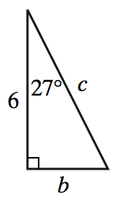
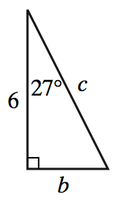
Example: Given a right triangle with one leg of length 6 and an adjacent angle of 27°, find the other two sides and the remaining angles.
The other acute angle is \( 90^\circ - 27^\circ = 63^\circ \).
Use trigonometric ratios to solve for the unknown sides:
\( \tan 27^\circ = \frac{6}{b} \Rightarrow b = \frac{6}{\tan 27^\circ} \)
\( \sin 27^\circ = \frac{6}{c} \Rightarrow c = \frac{6}{\sin 27^\circ} \)
