 Back
BackUnit Circle Approach and Properties of Trigonometric Functions
Study Guide - Smart Notes
 Tailored notes based on your materials, expanded with key definitions, examples, and context.
Trigonometric Functions: Unit Circle Approach
Definition and Exact Values Using the Unit Circle
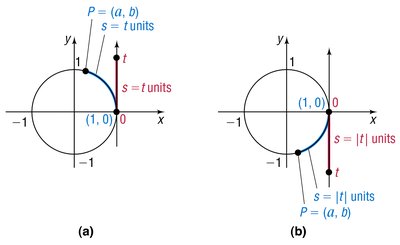
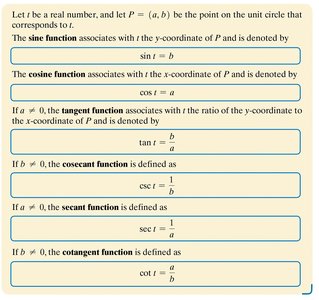
The unit circle approach is fundamental in precalculus for defining and evaluating trigonometric functions. The unit circle is a circle of radius 1 centered at the origin in the coordinate plane. Each real number t corresponds to a point P = (a, b) on the unit circle, and the trigonometric functions are defined based on the coordinates of this point.
Sine function:
Cosine function:
Tangent function: ,
Cosecant function: ,
Secant function: ,
Cotangent function: ,
Example: Finding Exact Values
Given P = (–3/2, –1/2) on the unit circle:
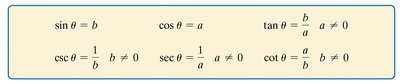
Trigonometric Functions for Angles on Circles of Radius r
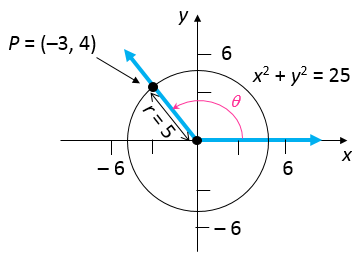
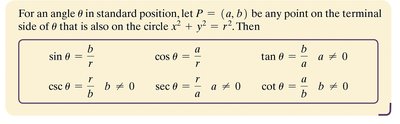
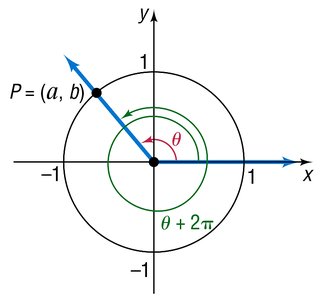
For an angle θ in standard position, let P = (a, b) be any point on the terminal side of θ that is also on the circle . The trigonometric functions are defined as:
,
,
,
,
Special Right Triangles and Trigonometric Values
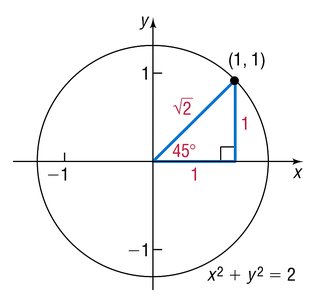
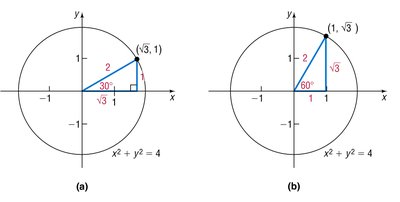
Special right triangles, such as the 45-45-90 and 30-60-90 triangles, are used to find exact values of trigonometric functions for common angles.
45-45-90 Triangle: Both legs are equal, hypotenuse is times a leg.
30-60-90 Triangle: Shorter leg is half the hypotenuse, longer leg is times the shorter leg.
Domain and Range of Trigonometric Functions
Domain of Trigonometric Functions
The domain of a function is the set of all possible input values (θ) for which the function is defined.
Sine and Cosine: All real numbers
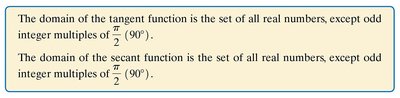
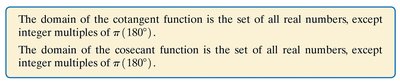
Tangent and Secant: All real numbers except odd integer multiples of (90°)
Cotangent and Cosecant: All real numbers except integer multiples of (180°)

Range of Trigonometric Functions
The range of a function is the set of all possible output values.
Sine and Cosine: ,
Secant and Cosecant: or , or
Tangent and Cotangent: ,




Summary Table: Domains and Ranges
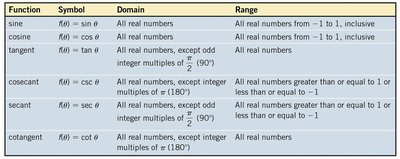
The following table summarizes the domains and ranges of the six trigonometric functions:
Function | Symbol | Domain | Range |
|---|---|---|---|
Sine | All real numbers | All real numbers from –1 to 1, inclusive | |
Cosine | All real numbers | All real numbers from –1 to 1, inclusive | |
Tangent | All real numbers, except odd integer multiples of (90°) | All real numbers | |
Cosecant | All real numbers, except integer multiples of (180°) | All real numbers greater than or equal to 1 or less than or equal to –1 | |
Secant | All real numbers, except odd integer multiples of (90°) | All real numbers greater than or equal to 1 or less than or equal to –1 | |
Cotangent | All real numbers, except integer multiples of (180°) | All real numbers |
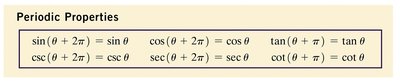
Periodic Properties of Trigonometric Functions
Definition of Periodic Functions
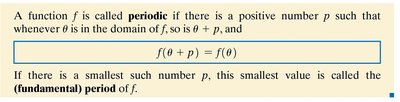
A function f is periodic if there is a positive number p such that for all θ in the domain. The smallest such p is called the fundamental period of f.
Periodic Properties of Trigonometric Functions
Even-Odd Properties of Trigonometric Functions
Definition and Properties
Trigonometric functions exhibit even-odd properties, which describe their symmetry with respect to the y-axis or origin.
(odd)
(even)
(odd)
(odd)
(even)
(odd)

Example: Using Even-Odd Properties
Summary
The unit circle approach provides a geometric foundation for defining and evaluating trigonometric functions. Understanding the domains, ranges, periodicity, and symmetry properties of these functions is essential for solving problems in precalculus and beyond.
