 Back
BackUnit Circle, Radian Measure, and Trigonometric Functions: Study Guide
Study Guide - Smart Notes
 Tailored notes based on your materials, expanded with key definitions, examples, and context.
Unit Circle and Angle Measurement
Degrees and Radians
The measurement of angles is fundamental in trigonometry. Angles can be measured in degrees or radians:
Degrees: One full circle is 360 degrees. This system is convenient due to its many divisors.
Radians: One full circle is radians. Radians are based on the arc length of a unit circle, making them natural for mathematical analysis.
To convert between degrees and radians:
Degrees to radians: Multiply by
Radians to degrees: Multiply by
Angles in Standard Position
An angle is in standard position when its vertex is at the origin and its initial side lies along the positive x-axis. The terminal side is rotated counterclockwise for positive angles and clockwise for negative angles.
The Unit Circle
The unit circle is a circle of radius 1 centered at the origin. It is used to define trigonometric functions for all real numbers. Key angles are marked in both degrees and radians, and their coordinates correspond to the values of sine and cosine.
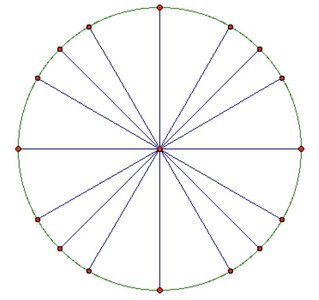
Additional info: The image above shows the unit circle divided into equal segments, each representing a key angle. The red points correspond to the intersection of the terminal sides of these angles with the circle.
Trigonometric Functions on the Unit Circle
Sine, Cosine, and Tangent
For an angle in standard position, the coordinates of the point where the terminal side intersects the unit circle are .
Sine: is the y-coordinate.
Cosine: is the x-coordinate.
Tangent:
In a right triangle:
Key Values for Special Angles
Some angles have well-known sine and cosine values, which are essential for solving trigonometric problems:
$0$ | |||||
|---|---|---|---|---|---|
0 | 1 | ||||
1 | 0 |
Symmetry and Related Angles
Symmetry on the Unit Circle
The unit circle exhibits symmetry, which allows us to relate the sine and cosine of one angle to those of related angles:
These properties are useful for finding trigonometric values for angles outside the first quadrant.
Pythagorean Identity
Fundamental Relationship
The Pythagorean identity connects sine and cosine:
This identity is derived from the equation of the unit circle and is fundamental in solving trigonometric equations.
Solving Trigonometric Equations
Finding Angles for Given Values
To solve equations such as , identify all angles whose sine is within the specified interval. Use the unit circle and symmetry to find all solutions.
Example: has solutions and in .
For equations involving cosine or tangent, use similar reasoning and the properties of the unit circle.
Applications and Practice Problems
Real-World Applications
Trigonometric functions are used to solve problems involving heights, distances, and angles. For example, if a kite string forms a angle with the ground and is 450 ft long, the height of the kite is ft.
Practice Problems
Find the sine, cosine, and tangent for a given point on the unit circle.
Solve trigonometric equations for specified intervals.
Simplify trigonometric expressions using identities.
Additional info: Practice problems reinforce understanding of the unit circle, trigonometric functions, and their applications.
