 Back
BackVector Operations: Finding a - b Using a Graph
Study Guide - Smart Notes
 Tailored notes based on your materials, expanded with key definitions, examples, and context.
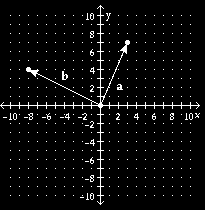
Q35. Find the vector a - b using the given graph.
Background
Topic: Vector Operations
This question tests your understanding of vector subtraction using graphical representations. You are asked to find the vector difference a - b, which means subtracting vector b from vector a.
Key Terms and Formulas:
Vector subtraction: If vectors a and b are given as and , then a - b = .
Component form: Vectors are often written as where x is the horizontal component and y is the vertical component.
Step-by-Step Guidance
Identify the coordinates of vector a and vector b from the graph. Vector a starts at the origin and ends at (3, 7). Vector b starts at the origin and ends at (-8, 3).
Write the component forms: a = <3, 7>, b = <-8, 3>.
Set up the subtraction: a - b = <3, 7> - <-8, 3>.
Subtract the corresponding components: For the x-component, subtract -8 from 3. For the y-component, subtract 3 from 7.
Try solving on your own before revealing the answer!
Final Answer: <11, 4>
Subtracting the components gives the vector <11, 4>, which represents the difference between a and b.
