 Back
BackVerifying Trigonometric Identities: Fundamental Techniques and Examples
Study Guide - Smart Notes
 Tailored notes based on your materials, expanded with key definitions, examples, and context.
Verifying Trigonometric Identities
Introduction to Trigonometric Identities
Trigonometric identities are equations involving trigonometric functions that are true for all values within their domains. Verifying these identities is a fundamental skill in precalculus, as it strengthens algebraic manipulation and understanding of trigonometric relationships.
Trigonometric identities include reciprocal, quotient, Pythagorean, and even-odd identities.
Verification involves transforming one side of an equation to match the other using algebraic and trigonometric properties.
Fundamental Trigonometric Identities
These identities form the basis for most manipulations and verifications in trigonometry.
Reciprocal Identities:
Quotient Identities:
Pythagorean Identities:
Even-Odd Identities:
Techniques for Verifying Identities
General Approach
To verify a trigonometric identity, manipulate one side (usually the more complex) using fundamental identities and algebraic techniques until it matches the other side.
Work independently on each side of the equation.
Start with the more complicated side.
Apply substitutions, factoring, and common denominators as needed.
Examples of Verifying Trigonometric Identities
Example 1: Changing to Sines and Cosines
Verify the identity:
Rewrite each function in terms of sine and cosine:
, ,
Multiply:
Conclusion: The identity is verified.
Example 2: Using Factoring
Verify the identity:
Factor from the left side:
Rewrite as using the Pythagorean identity.
Multiply:
Rearrange:
Conclusion: The identity is verified.
Example 3: Combining Fractional Expressions
Verify the identity:
Find the least common denominator (LCD):
Rewrite each fraction with the LCD:
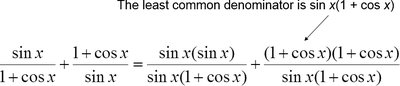
Expand and simplify the numerators, combine like terms, and factor as needed.
Final simplification yields .
Conclusion: The identity is verified.
Example 4: Working with Both Sides Separately
Verify the identity:
Rewrite each fraction with the LCD:

Expand numerators and simplify using algebraic and trigonometric identities.
Work with both sides independently until they match.
Conclusion: The identity is verified.
Summary Table: Fundamental Trigonometric Identities
Identity Type | Formula |
|---|---|
Reciprocal | , , |
Quotient | , |
Pythagorean | , , |
Even-Odd | , , |
Key Takeaway: Mastery of fundamental identities and algebraic manipulation is essential for verifying trigonometric identities in precalculus.
