 Back
BackVertical and Oblique Asymptotes of Rational Functions
Study Guide - Smart Notes
 Tailored notes based on your materials, expanded with key definitions, examples, and context.
Limits and Asymptotic Behavior of Functions
Understanding Limits Near a Point
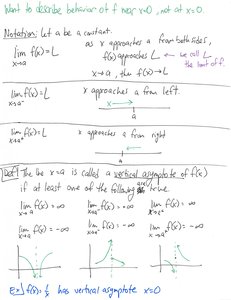
In precalculus, it is important to describe the behavior of a function f as x approaches a value a, but not necessarily at x = a. This is done using the concept of limits.
Limit from both sides: means as x approaches a from both sides, f(x) approaches L.
Left-hand limit: means x approaches a from the left.
Right-hand limit: means x approaches a from the right.
Vertical Asymptotes
A vertical asymptote of a function f(x) is a vertical line x = a where the function increases or decreases without bound as x approaches a from either side. This occurs if at least one of the following is true:
Example: has a vertical asymptote at x = 0.
Rational Functions and Vertical Asymptotes
Definition and Identification
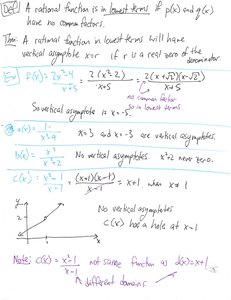
A rational function is in lowest terms if the numerator p(x) and denominator q(x) have no common factors. A rational function in lowest terms will have a vertical asymptote at x = r if r is a real zero of the denominator.
Example: has vertical asymptotes at and .
No vertical asymptotes: If the denominator has no real zeros, there are no vertical asymptotes.
Removable discontinuity (hole): If a factor cancels in numerator and denominator, the function has a hole, not a vertical asymptote.
Function | Vertical Asymptotes | Notes |
|---|---|---|
Denominator zeros | ||
None | No real zeros in denominator | |
Vertical asymptote at | ||
None | Hole at (removable) |
Note: is not the same function as ; they have different domains.
Oblique (Slant) Asymptotes
Definition and Identification
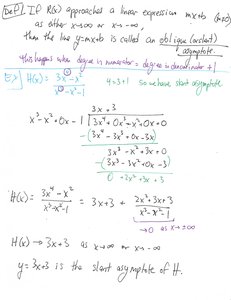
If a rational function approaches a linear expression as or , then the line is called an oblique (slant) asymptote. This occurs when the degree of the numerator is exactly one more than the degree of the denominator.
Example:
Divide numerator by denominator:
As ,
Thus, is the slant asymptote of .
Summary Table:
Type of Asymptote | How to Find | Example |
|---|---|---|
Vertical | Set denominator = 0 (after simplification) | at |
Oblique (Slant) | Degree numerator = 1 + degree denominator; divide | , |
