Back
Vertical Shifts of Functions: Domain and Range
Study Guide - Smart Notes
 Tailored notes based on your materials, expanded with key definitions, examples, and context.
Vertical Shifts of Functions
Understanding Vertical Shifts
Vertical shifts are transformations that move the graph of a function up or down without affecting its shape. These shifts only impact the range of the function, not the domain.
Vertical Shift Up: If a positive real number k is added to the output of a function f(x), the graph of the new function f(x) + k is shifted vertically up by k units.
Vertical Shift Down: If a positive real number k is subtracted from the output of a function f(x), the graph of the new function f(x) - k is shifted vertically down by k units.
Example: Vertical Shift Down
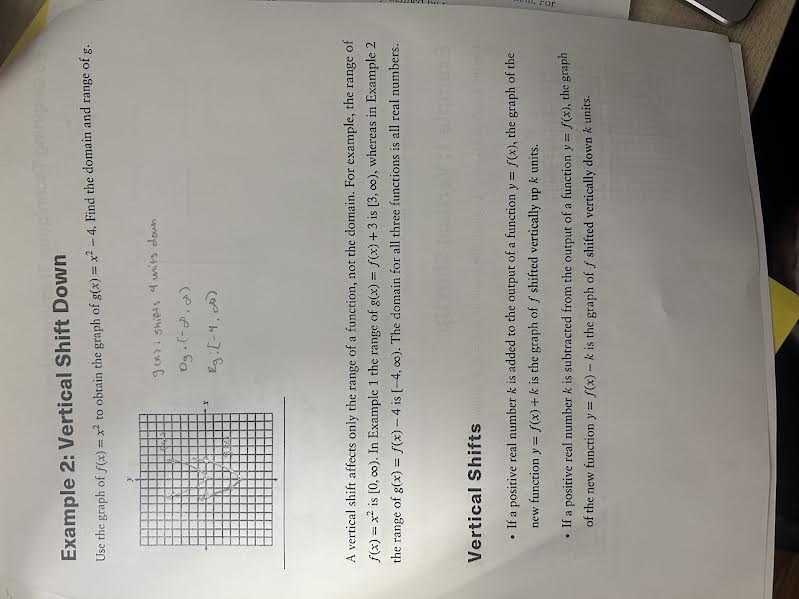
Consider the function f(x) = x2. The graph of g(x) = x2 - 4 is obtained by shifting the graph of f(x) downward by 4 units.
Domain of f(x):
Range of f(x):
Domain of g(x):
Range of g(x):
Explanation: The domain remains unchanged because the transformation does not affect the input values. The range is shifted down by 4 units, so the minimum value of g(x) is -4 instead of 0.
General Formula for Vertical Shifts
For f(x) + k: Range is shifted up by k units.
For f(x) - k: Range is shifted down by k units.
Example: If f(x) = x2, then:
f(x) + 3: Range is
f(x) - 4: Range is