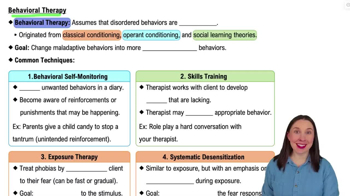
A therapeutic approach focused on modifying maladaptive actions using principles from behaviorism, emphasizing observable change over emotions or thoughts.
Operant Conditioning
A learning process where behaviors are shaped by consequences, such as reinforcements or punishments, influencing future actions.
Classical Conditioning
A learning method where associations are formed between a neutral stimulus and a naturally occurring response, often used to address fears.
Behavioral Self-Monitoring
A technique involving tracking actions and their triggers to uncover patterns of reinforcement or punishment maintaining unwanted habits.
Skills Training
A process where clients develop lacking abilities, often through modeling and role-play, to handle specific challenges like social interactions.
Exposure Therapy
A method that gradually or rapidly presents feared stimuli without negative outcomes, aiming to reduce anxiety through habituation.
Systematic Desensitization
A technique pairing gradual exposure to fears with relaxation exercises, reconditioning responses from anxiety to calmness.
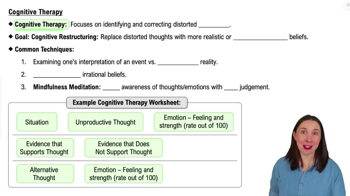
Cognitive Therapy
An approach targeting distorted beliefs and thought patterns, aiming to replace them with more realistic and productive alternatives.
Cognitive Restructuring
A process of identifying and replacing irrational or unhelpful beliefs with balanced, evidence-based thoughts.
Cognitive Bias
A habitual pattern of distorted thinking that can contribute to emotional difficulties and maintain psychological disorders.
Mindfulness Meditation
A practice of observing thoughts and emotions nonjudgmentally, fostering awareness and reducing reactivity to internal experiences.
Cognitive Behavioral Therapy
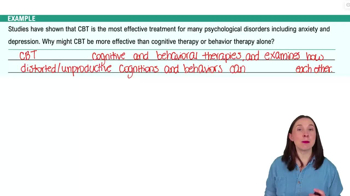
A combined approach integrating behavioral and cognitive techniques to address the interplay of thoughts, emotions, and actions.
Psychological Well-Being
A state reflecting positive mental health, often enhanced through interventions that improve thoughts, emotions, and behaviors.
Randomized Clinical Trial
A research method providing strong evidence for treatment effectiveness by randomly assigning participants to different interventions.
 Back
Back
 06:00
06:00