Receiving water when thirsty is a scenario describing a primary reinforcer.
Based on the principle of spontaneous recovery, what would you predict about Little Albert's conditioned fear?
After extinction, Little Albert's conditioned fear could spontaneously reappear after a period of rest.
What best reflects contemporary interpretations of classical conditioning?
Contemporary interpretations emphasize that classical conditioning involves learning that the conditioned stimulus predicts the unconditioned stimulus.
What is classical conditioning?
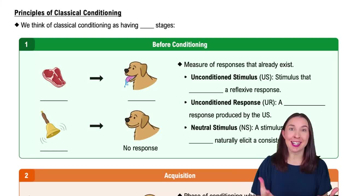
Classical conditioning is a form of learning in which a neutral stimulus is paired with an unconditioned stimulus until the neutral stimulus elicits a conditioned response.
Why does taste aversion break the typical rules of conditioning?
Taste aversion can occur after a single pairing and with a long delay between stimulus and response, unlike most forms of classical conditioning.
What happened after Watson classically conditioned Little Albert to fear a tame white rat?
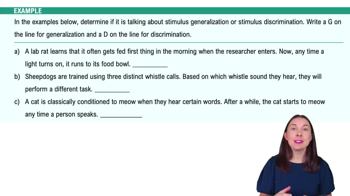
Little Albert began to show fear responses not only to the white rat but also to similar stimuli, demonstrating stimulus generalization.
Which is not an example of a conditioned response?
Reflexively blinking in response to a puff of air is not a conditioned response; it is an unconditioned response.
In Pavlov's study, what was the role of the bell?
In Pavlov's study, the bell was initially a neutral stimulus that became a conditioned stimulus after being paired with food.
What was the neutral stimulus in Pavlov's original experiment?
The neutral stimulus in Pavlov's original experiment was the sound of a bell.
Which is not an example of an unconditioned response?
Salivating to the sound of a bell after conditioning is not an unconditioned response; it is a conditioned response.
What term is used for reinforcers that are learned by association?
Secondary reinforcers are learned by association.
Which is not a part of stimulus generalization?
Responding only to the conditioned stimulus and not to similar stimuli is not part of stimulus generalization; it is stimulus discrimination.
Pavlov developed methods and theories for understanding behavior in terms of which process?
Pavlov developed methods and theories for understanding behavior in terms of associative learning and conditioning.
What type of behavior occurs as an automatic response to a stimulus?
Respondent behavior occurs as an automatic response to a stimulus.
How did the bell and pad device solve the problem of bed-wetting in terms of conditioning?
The bell and pad device used classical conditioning by pairing the sensation of a full bladder (neutral stimulus) with the sound of a bell (unconditioned stimulus) to condition waking up before wetting the bed.
What was the most important takeaway from Ivan Pavlov’s experiment with dogs?
The most important takeaway was that organisms can learn to associate a neutral stimulus with an unconditioned stimulus to produce a conditioned response.
Pavlov’s experiments with dogs yielded information about which psychological process?
Pavlov’s experiments yielded information about classical conditioning and associative learning.
Primary reinforcers are _____, whereas secondary reinforcers are learned.
Primary reinforcers are naturally reinforcing, whereas secondary reinforcers are learned.
Extinction occurs when a ________ is no longer paired with a ________.
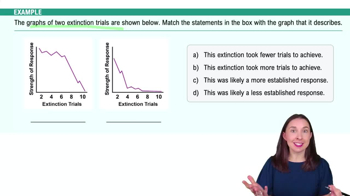
Extinction occurs when a conditioned stimulus is no longer paired with an unconditioned stimulus.
Before Pavlov conditioned a dog to salivate in response to a tone, the tone was a(n) _____ stimulus.
Before conditioning, the tone was a neutral stimulus.
Does classical conditioning occur when a particular behavior is reinforced by its consequences?
No, classical conditioning involves associating two stimuli, not reinforcement by consequences.
What is the tendency for stimuli similar to the conditioned stimulus to elicit a conditioned response called?
This tendency is called stimulus generalization.
What is the sudden reappearance of an extinguished response called?
The sudden reappearance of an extinguished response is called spontaneous recovery.
A stimulus that produces a response without prior learning is a(n) _____ stimulus.
A stimulus that produces a response without prior learning is an unconditioned stimulus.
What occurs when a conditioned response decreases and eventually disappears?
This process is called extinction.
What is the conditioned stimulus (CS) in a classical conditioning scenario?
The conditioned stimulus is a previously neutral stimulus that, after being paired with the unconditioned stimulus, elicits a conditioned response.
Which would be considered a primary reinforcer?
Food is considered a primary reinforcer.
Respondent behavior is to operant behavior as _____ is to _____.
Respondent behavior is to operant behavior as automatic response is to voluntary response.
What is systematic desensitization in psychology?
Systematic desensitization is a therapeutic technique that uses classical conditioning to gradually reduce anxiety by associating relaxation with a feared stimulus.
What type of behavior occurs as an automatic response to a stimulus?
Respondent behavior occurs as an automatic response to a stimulus.
What is learning in which stimuli associated with a conditioned stimulus also elicit conditioned responses?
This is called stimulus generalization.
What is a learned response to a previously neutral stimulus called?
A learned response to a previously neutral stimulus is called a conditioned response.
What is a stimulus that was previously neutral but is now associated with the unconditioned stimulus?
This is called a conditioned stimulus.
Who is credited with laying the foundation for the study of classical conditioning in psychology?
Ivan Pavlov is credited with laying the foundation for the study of classical conditioning.
When a previously conditioned response decreases and eventually disappears, what is this process called?
This process is called extinction.
A stimulus that produces a response without prior learning is a(n) _____ stimulus.
A stimulus that produces a response without prior learning is an unconditioned stimulus.
Acquiring a phobia is to maintaining a phobia as _____ conditioning is to _____ conditioning.
Acquiring a phobia is to maintaining a phobia as classical conditioning is to operant conditioning.
In classical conditioning, what is the learned reaction to a previously neutral stimulus called?
The learned reaction is called the conditioned response.
What is learning that occurs when stimuli similar but not identical to the conditioned stimulus produce the conditioned response?
This is called stimulus generalization.
What is a neutral change that does not elicit respondent behavior?
A neutral stimulus is a change that does not elicit respondent behavior before conditioning.
 Back
Back
 06:45
06:45