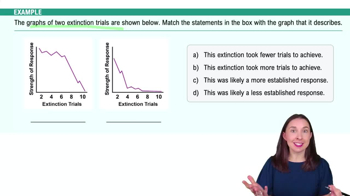
What is the process in which a conditioned stimulus becomes neutral again called?
This process is called extinction.
A child's learned fear at the sight of a hypodermic needle is a(n) _____ response.
It is a conditioned response.
Which branch of psychology focuses on subjects such as conditioning?
Behavioral psychology focuses on subjects such as conditioning.
What is an unlearned and automatic response to a stimulus called?
An unlearned and automatic response to a stimulus is called an unconditioned response.
Which are among Pavlov's fundamental criteria for stimulus-response conditioning?
Pairing a neutral stimulus with an unconditioned stimulus and ensuring the neutral stimulus precedes the unconditioned stimulus are fundamental criteria.
A response elicited by the conditioned stimulus is referred to as a(n) _____ response.
A response elicited by the conditioned stimulus is referred to as a conditioned response.
Classical conditioning is most efficient when the unconditioned stimulus (UCS) is presented when?
Classical conditioning is most efficient when the neutral stimulus precedes the unconditioned stimulus.
What are unlearned, involuntary responses that occur automatically in the presence of certain stimuli?
Unconditioned responses are unlearned, involuntary responses that occur automatically in the presence of certain stimuli.
Classical and operant conditioning are forms of _____ learning.
Classical and operant conditioning are forms of associative learning.
When a stimulus delta is presented, what happens to a particular response?
When a stimulus delta is presented, the particular response is not reinforced or does not occur.
In classical conditioning, what association is learned?
The association learned is between a neutral stimulus and an unconditioned stimulus.
When does learning occur in classical conditioning?
Learning occurs when a connection or association is made between two events: the neutral stimulus and the unconditioned stimulus.
What is an unconditioned response?
An unconditioned response is an automatic, unlearned reaction to an unconditioned stimulus.
What is conditioning in psychology?
Conditioning is the process of learning associations between environmental stimuli and behavioral responses.
What is classical conditioning practice?
Classical conditioning practice involves pairing a neutral stimulus with an unconditioned stimulus to produce a conditioned response.
Once a conditioned behavior is extinguished, can it appear again?
Yes, a conditioned behavior can reappear through spontaneous recovery after extinction.
What is the difference between classical and operant conditioning?
Classical conditioning involves learning associations between stimuli, while operant conditioning involves learning through consequences of behavior.
If Molly attempts to condition her puppy, what process is she using?
Molly is using classical conditioning if she pairs a neutral stimulus with an unconditioned stimulus to elicit a conditioned response.
Which procedure includes extinction in classical conditioning?
Extinction occurs when the conditioned stimulus is presented repeatedly without the unconditioned stimulus.
Which experiment involves the use of classical conditioning?
Pavlov's dog experiment, where a bell is paired with food to elicit salivation, involves classical conditioning.
What is the definition of classical conditioning in AP Psychology?
Classical conditioning is a type of learning in which a neutral stimulus is paired with an unconditioned stimulus until it elicits a conditioned response.
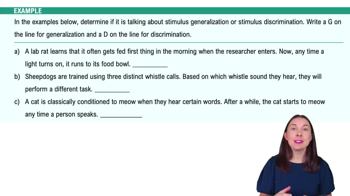
What is an example of stimulus discrimination in classical conditioning?
Stimulus discrimination is when an organism responds only to the conditioned stimulus and not to similar stimuli.
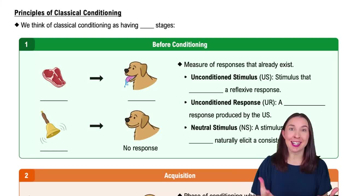
What is the correct order of events for classical conditioning to occur?
The correct order is: present the neutral stimulus, then the unconditioned stimulus, repeat the pairing, and eventually the neutral stimulus becomes a conditioned stimulus eliciting a conditioned response.
A person attacked by a fierce dog develops a fear of all dogs. What does this illustrate?
This illustrates stimulus generalization.
What is an unconditioned response in classical conditioning?
An unconditioned response is an automatic, unlearned reaction to an unconditioned stimulus.
In classical conditioning, a stimulus is used to provoke or elicit a response that _____?
In classical conditioning, a stimulus is used to provoke or elicit a response that is learned through association.
Why was Pavlov's research on classical conditioning important?
Pavlov's research was important because it demonstrated that organisms can learn to associate a neutral stimulus with an unconditioned stimulus to produce a conditioned response.
Classical conditioning involves _____, while operant conditioning involves _____.
Classical conditioning involves associating stimuli, while operant conditioning involves associating behavior with consequences.
What is acquisition in classical conditioning?
Acquisition is the initial learning phase when the neutral stimulus is repeatedly paired with the unconditioned stimulus, leading to a conditioned response.
In the development of Karl’s fear of cats, what was the unconditioned stimulus (UCS)?
The unconditioned stimulus would be the event or experience that naturally elicited fear, such as being scratched or startled by a cat.
In the context of learning, what is true of conditioning?
Conditioning is a process of learning associations between environmental stimuli and behavioral responses.
What does classical conditioning involve?
Classical conditioning involves learning to associate a neutral stimulus with an unconditioned stimulus to elicit a conditioned response.
What is aversive conditioning?
Aversive conditioning is a type of classical conditioning in which a neutral stimulus is paired with an unpleasant unconditioned stimulus to produce a negative conditioned response.
Which behavioral learning theorist is most closely associated with classical conditioning?
Ivan Pavlov is the behavioral learning theorist most closely associated with classical conditioning.
What area of study did Ivan Pavlov pioneer in psychology?
Ivan Pavlov pioneered the study of classical conditioning in psychology.
What is a classic experiment that demonstrates the process of classical conditioning?
A classic experiment demonstrating classical conditioning is Ivan Pavlov's study where he paired a neutral stimulus (a bell) with an unconditioned stimulus (food) to elicit a conditioned response (salivation) in dogs.
Who is considered the father of classical conditioning?
Ivan Pavlov is considered the father of classical conditioning.
Who discovered the basic process of classical conditioning?
Ivan Pavlov discovered the basic process of classical conditioning.
Who is credited with the discovery of classical conditioning?
Ivan Pavlov is credited with the discovery of classical conditioning.
What is the term for learning that certain events occur together?
The term for learning that certain events occur together is associative learning, which is exemplified by classical conditioning.
 Back
Back
 06:45
06:45