Skip to main content
Introduction to Psychology
My Course
Learn
Exam Prep
AI Tutor
Study Guides
Flashcards
Explore
Try the app
My Course
Learn
Exam Prep
AI Tutor
Study Guides
Flashcards
Explore
Try the app
Back
Conformity quiz
You can tap to flip the card.
What is conformity as defined in psychology?
You can tap to flip the card.
👆
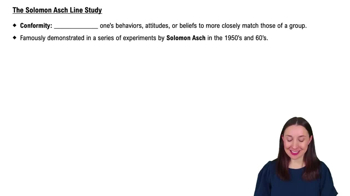
What is conformity as defined in psychology?
Conformity is changing one's behaviors, attitudes, or beliefs to more closely match those of a group.
Track progress
Control buttons has been changed to "navigation" mode.
1/15
Related flashcards
Related practice
Recommended videos
Conformity definitions
Conformity
14 Terms
Conformity
12. Social Psychology
7 problems
Topic
Nicole
Obedience
12. Social Psychology
7 problems
Topic
Nicole
12. Social Psychology - Part 1 of 2
3 topics
9 problems
Chapter
Nicole
12. Social Psychology - Part 2 of 2
3 topics
9 problems
Chapter
Nicole
Guided course
00:37
Example 1
465
views
1
rank
Guided course
04:13
Factors that Affect Conformity
519
views
2
rank
Guided course
04:03
The Solomon Asch Line Study
594
views
8
rank
Terms in this set (15)
Hide definitions
What is conformity as defined in psychology?
Conformity is changing one's behaviors, attitudes, or beliefs to more closely match those of a group.
What was the main task participants had to perform in the Solomon Asch line study?
Participants had to match the length of a target line to one of three comparison lines.
Who were the Confederates in the Asch line study?
Confederates were trained actors who pretended to be participants but actually worked for the experimenter.
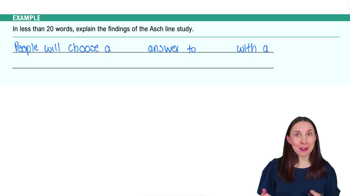
What percentage of participants conformed to the group's incorrect answer in the Asch study?
About 37% of participants conformed to the group's wrong responses.
How did participants perform on the line-matching task when they were alone?
Participants had about 99% accuracy when performing the task alone.
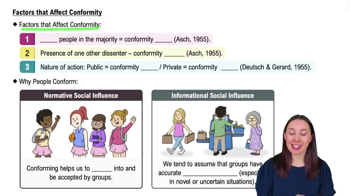
What effect does group size have on conformity?
In general, the larger the majority group, the more likely individuals are to conform.
How does the presence of a dissenter affect conformity?
The presence of one other person who disagrees with the majority can decrease conformity.
How does the public or private nature of behavior influence conformity?
People are more likely to conform in public settings and less likely to conform in private.
What is normative social influence?
Normative social influence is conforming to fit in and be accepted by a group.
What is informational social influence?
Informational social influence is conforming because we believe the group has accurate information, especially in uncertain situations.
Why did Asch design the line-matching task to be very easy?
He wanted to ensure participants were not genuinely confused and that conformity was not due to uncertainty about the correct answer.
What proportion of participants gave the wrong answer at least once in the Asch study?
About 75% of participants conformed and gave the wrong answer at least once.
Why is conformity considered a neutral behavior in academic psychology?
Conformity is seen as a common and necessary part of fitting into society, not inherently good or bad.
Give an example of informational social influence from everyday life.
Watching others use a new self-checkout machine at a grocery store and copying their behavior is an example of informational social influence.
How does concern about social evaluation affect conformity?
People are more likely to conform when they are concerned about being judged by others, especially in public situations.
 BackBack
 00:37
00:37