Skip to main content
Introduction to Psychology
My Course
Learn
Exam Prep
AI Tutor
Study Guides
Flashcards
Explore
Try the app
My Course
Learn
Exam Prep
AI Tutor
Study Guides
Flashcards
Explore
Try the app
Back
Diagnosing Psychological Disorders quiz #2
You can tap to flip the card.
Which statements about cheating are true?
You can tap to flip the card.
👆
Which statements about cheating are true?
Cheating is a maladaptive behavior that may cause distress and impairment in functioning.
Track progress
Control buttons has been changed to "navigation" mode.
1/39
Related flashcards
Related practice
Recommended videos
Diagnosing Psychological Disorders quiz #1
Diagnosing Psychological Disorders
38 Terms
Diagnosing Psychological Disorders quiz #3
Diagnosing Psychological Disorders
38 Terms
Diagnosing Psychological Disorders quiz #4
Diagnosing Psychological Disorders
40 Terms
Diagnosing Psychological Disorders
14. Psychological Disorders
7 problems
Topic
Nicole
Perspectives on Psychological Disorders
14. Psychological Disorders
7 problems
Topic
Nicole
14. Psychological Disorders
5 topics
11 problems
Chapter
Nicole
Guided course
01:55
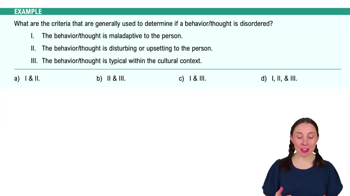
Example 3
573
views
1
rank
Guided course
00:55
Example 1
474
views
10
rank
Guided course
04:55
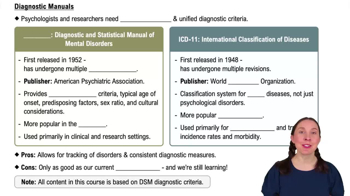
Diagnostic Manuals
489
views
4
rank
Terms in this set (39)
Hide definitions
Which statements about cheating are true?
Cheating is a maladaptive behavior that may cause distress and impairment in functioning.
Which conditions can mimic the signs of alcohol intoxication?
Medical or psychological conditions that impair cognition or motor function can mimic alcohol intoxication.
What is the most widely known diagnosis of fetal alcohol spectrum disorders (FASDs)?
Fetal Alcohol Syndrome is the most widely known diagnosis of FASDs.
What is the most common behavioral disorder found in older adults?
Dementia is the most common behavioral disorder found in older adults.
What is among the criteria for diagnosing bulimia nervosa?
Recurrent episodes of binge eating followed by compensatory behaviors are criteria for bulimia nervosa.
What elevates the risk for developing PTSD?
Exposure to traumatic events increases the risk for developing PTSD.
Which two population groups have a higher rate of mental health disturbances?
Adolescents and young adults have higher rates of mental health disturbances.
How is dementia best described?
Dementia is a significant disturbance in cognition that impairs functioning.
What can dealing with the stigma of having a disorder do?
Stigma can increase distress and impairment for individuals with psychological disorders.
What is true of binge eating disorder (BED)?
BED involves recurrent episodes of eating large amounts of food with distress and impairment, but without compensatory behaviors.
Which drug is not one of the most abused prescription medications?
A drug not commonly associated with maladaptive use and impairment is not among the most abused prescription medications.
The Maslach Burnout Inventory (MBI) is an example of which type of measure?
The MBI is a standardized self-report inventory used to assess symptoms of burnout.
Which people are most at risk for abuse?
Individuals who are vulnerable due to impairment in functioning or atypical behavior are most at risk for abuse.
A person with substance abuse disorder would be diagnosed with which type of disorder?
Substance use disorder is diagnosed when maladaptive substance use causes distress or impairment.
What is the hallmark of somatic symptom and related disorders?
Physical complaints that cannot be fully explained medically and cause distress or impairment are the hallmark.
What is the most frequent outcome for those found not guilty by reason of insanity (NGRI)?
The most frequent outcome is commitment to a psychiatric facility for treatment.
What is not needed when describing a patient's chief complaint?
Information unrelated to the patient's distress or impairment is not needed.
What is true about the ICD classification system for mental disorders?
The ICD provides standardized criteria for mental disorders and is used globally for tracking and insurance purposes.
What is true of binge-eating disorder?
Binge-eating disorder involves recurrent episodes of eating large amounts of food with distress, but without compensatory behaviors.
What is not one of the four subtypes of intellectual disability?
A subtype not defined by standardized criteria in the DSM-5 is not one of the four subtypes.
What is a criticism of the DSM?
A criticism is that the DSM is only as good as current research and may not fully capture the complexity of psychological disorders.
What is true regarding ADHD in children?
ADHD in children is characterized by maladaptive patterns of inattention and/or hyperactivity that cause impairment.
What is an important symptom of antisocial personality disorder?
A lack of conscience and disregard for others' rights is an important symptom.
What is the M'Naghten rule?
The M'Naghten rule is a legal standard for insanity, focusing on whether a person understood the nature of their act.
What is the most prevalent psychological disorder in the general population?
Anxiety disorders are the most prevalent psychological disorders.
What are criteria used to diagnose alcohol use disorders?
Maladaptive patterns of alcohol use causing distress or impairment are criteria for diagnosis.
When assessing a client for depression, which symptom should be prioritized?
Persistent depressed mood and impairment in functioning should be prioritized.
What is true of abnormal behavior?
Abnormal behavior is maladaptive, distressing, and atypical within cultural context.
What symptom would lead a practitioner to diagnose a paraphilic disorder?
Maladaptive sexual behaviors causing distress or impairment would lead to diagnosis.
How do delusions differ from normal beliefs?
Delusions are fixed, false beliefs that are not shared by others and are resistant to evidence.
What characteristic is not typical of people with work addiction?
A lack of distress or impairment is not typical; work addiction involves maladaptive patterns.
What is true regarding aphasia?
Aphasia is the loss of ability to speak, write, or comprehend language.
What is true about pedophilia?
Pedophilia is a psychological disorder characterized by maladaptive sexual interests causing distress or impairment.
Who is most likely to be diagnosed with excoriation disorder?
A person who repeatedly picks at their skin, causing distress and impairment, may be diagnosed with excoriation disorder.
Who most likely has obsessive-compulsive personality disorder?
A person with maladaptive patterns of perfectionism and control that cause distress and impairment may have obsessive-compulsive personality disorder.
What is true of expressed emotion and relapse in patients with schizophrenia?
High levels of expressed emotion in families are associated with increased risk of relapse in schizophrenia.
What is true about kleptomania?
Kleptomania is a psychological disorder involving recurrent urges to steal, causing distress or impairment.
What is not one of the DSM-5 criteria for insomnia disorder?
Symptoms unrelated to sleep disturbance and impairment are not criteria for insomnia disorder.
What is the biggest sign that someone might be dealing with a mental health challenge?
Significant distress or impairment in functioning is the biggest sign.
 BackBack
 01:55
01:55