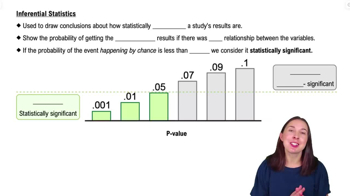
What is a key criterion for determining whether a research finding is statistically significant in psychological research?
A research finding is considered statistically significant if the p-value is less than 0.05, indicating that the probability of the result occurring by chance is less than 5%.
What is a serious concern associated with repeated-measures studies in psychological research?
A serious concern with repeated-measures studies is the potential for order effects, where participants' responses may be influenced by the sequence in which conditions are presented, rather than the experimental manipulation itself.
On what factors does the ability of a quasi-experiment to support a causal claim depend?
The degree to which a quasi-experiment supports a causal claim depends on the extent to which it controls for confounding variables and establishes temporal precedence, as well as how well it rules out alternative explanations.
What is generally true about the relationship between reliability and validity in psychological research?
A measure can be reliable (produce consistent results) without being valid (measuring what it is intended to measure), but a valid measure must also be reliable.
What are the main steps involved in evaluating psychological research findings?
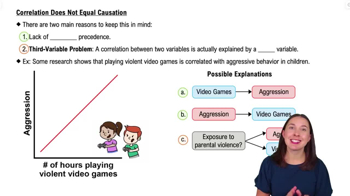
Evaluating psychological research findings involves examining descriptive statistics (mean, median, mode, range, standard deviation), interpreting correlation coefficients (strength and direction), and assessing statistical significance using inferential statistics (p-values), while considering the limitations of correlational research in establishing causation.
How can outliers affect the mean in a dataset?
Outliers can skew the mean by making it much higher or lower than most of the data points. This can result in the mean not accurately representing the typical value of the dataset.
What should you do to find the median in a dataset with an even number of values?
You should find the two middle values and calculate their average. This average becomes the median for the dataset.
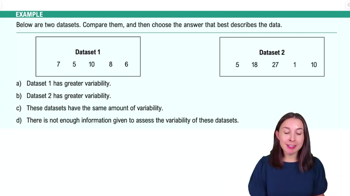
Why is it important to consider both measures of central tendency and measures of variability when evaluating a dataset?
Measures of central tendency alone may not reveal differences in data spread, which can be shown by measures of variability. Considering both gives a more complete understanding of how datasets differ.
What does a correlation coefficient of zero indicate about the relationship between two variables?
A correlation coefficient of zero means there is no relationship between the two variables. The variables do not move together in any predictable way.
Why is there no universal standard for labeling correlation strength in psychology?
Different fields and topics within psychology use varying descriptors for correlation strength. This lack of standardization means labels like 'strong' or 'weak' can differ across studies.
 Back
Back
 00:58
00:58