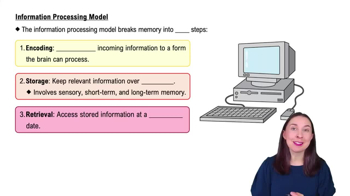
Which process is responsible for transferring information from sensory memory to short-term memory in the information processing model?
Encoding is the process that transfers information from sensory memory to short-term memory.
What is an example of acoustic encoding in the context of memory?
Acoustic encoding involves processing and remembering information based on sound, such as remembering a phone number by repeating it aloud.
What do information processing theories in psychology focus on?
Information processing theories focus on how the human mind encodes, stores, and retrieves information, similar to how a computer processes data.
What is a function of the information processing cycle in human memory?
A function of the information processing cycle is to encode, store, and retrieve information.
Which statement best describes the information processing model in psychology?
The information processing model describes memory as a system that encodes, stores, and retrieves information, similar to a computer.
What does information processing theory suggest about the composition of the workforce in terms of cognitive abilities?
Information processing theory suggests that understanding how people encode, store, and retrieve information can inform workforce training and composition by emphasizing cognitive skills relevant to job performance.
Which phase of the information processing model is most closely related to the perceptual system?
The encoding phase is most closely related to the perceptual system, as it involves transforming sensory input into neural signals.
What are the three main stages in the information processing model of memory?
The main stages are encoding, storage, and retrieval.
What are the steps the brain follows to learn new information according to the information processing model?
The brain learns new information by encoding sensory input, storing it in memory, and later retrieving it when needed.
Which computer-based model do psychologists use to explain the human learning process?
Psychologists use the information processing model, which likens human memory to computer functions, to explain the learning process.
What are the three parts of the information-processing model of memory?
The three parts are encoding, storage, and retrieval.
How is the information processing model described in AP Psychology?
In AP Psychology, the information processing model is described as a framework that explains memory in terms of encoding, storage, and retrieval, similar to computer operations.
The three basic aspects of information processing are encoding, storage, and what?
The three basic aspects are encoding, storage, and retrieval.
How do connectionist networks explain the organization of information in memory?
Connectionist networks explain that information is organized in memory through interconnected neural pathways, allowing for efficient storage and retrieval.
What is it called when information from prior learning helps a person understand new ideas?
This is called using prior knowledge or schema to facilitate the understanding of new information.
Information processing is a function of which human system?
Information processing is a function of the brain and nervous system.
What does the four-part processing model help us understand in cognitive psychology?
The four-part processing model helps us understand how information is encoded, stored, consolidated, and retrieved in memory.
Which type of processing involves the interpretation of sensations in the information processing model?
Encoding involves the interpretation of sensations by transforming sensory input into neural signals.
What is it called when a person accesses information from their own memory and knowledge?
Accessing information from one's own memory and knowledge is known as retrieval.
How does the information processing model describe the way humans process information?
The information processing model describes human information processing as a sequence of encoding, storage, and retrieval, similar to how a computer operates.
What are the three main components of the information-processing model of memory in psychology?
The three main components of the information-processing model of memory are encoding, storage, and retrieval.
In psychology, what does sequential processing refer to within the information-processing model?
Sequential processing in psychology refers to the step-by-step progression through the stages of the information-processing model: encoding information, storing it, and then retrieving it when needed.
 Back
Back
 01:41
01:41